


Podiatry Billing Services Built for Foot and Ankle Practices in California (CA)
California Billing Services handles podiatry medical billing and coding for DPMs, from routine foot care with class findings to wound debridement, diabetic shoes and bunion surgery. Claims are reviewed against documentation and payer requirements, with follow-up on outstanding balances.
- Routine foot care and class findings
- Wound care and surgery
- Diabetic shoes and DME
- California payer workflows
Why Podiatry Billing Breaks General Billing Workflows
Podiatry sits in an odd spot in U.S. reimbursement. Medicare excludes routine foot care by statute, then covers much of it again when the patient's records show the right systemic condition and class findings. One missing detail turns a covered visit into a non-covered one.
A general billing team usually sees a nail debridement as a simple code. A podiatry billing team sees the questions a payer will ask behind it:
Is it routine foot care or covered care? Coverage depends on the diagnosis, the class findings documented in the note, and the correct Q7, Q8 or Q9 modifier.
Who is managing the systemic condition? For many conditions, Medicare wants the name or NPI of the MD or DO actively treating the patient and the date they were last seen.
Which toe, which foot? T-modifiers (TA, T1–T9) and LT/RT drive both payment and NCCI edit outcomes.
Is this separately payable? An E/M on the same day as a minor procedure needs a significant, separately identifiable reason for modifier 25.
Which contractor gets the claim? Diabetic shoes and inserts go to a DME MAC under your DMEPOS supplier number, not to your Part B MAC.
When these details are missed, the result is not one denial. It is a pattern of low-dollar denials that nobody has time to rework, plus audit exposure if the documentation doesn't support what was paid. Our podiatry billing services are built to catch these issues before the claim leaves your system.
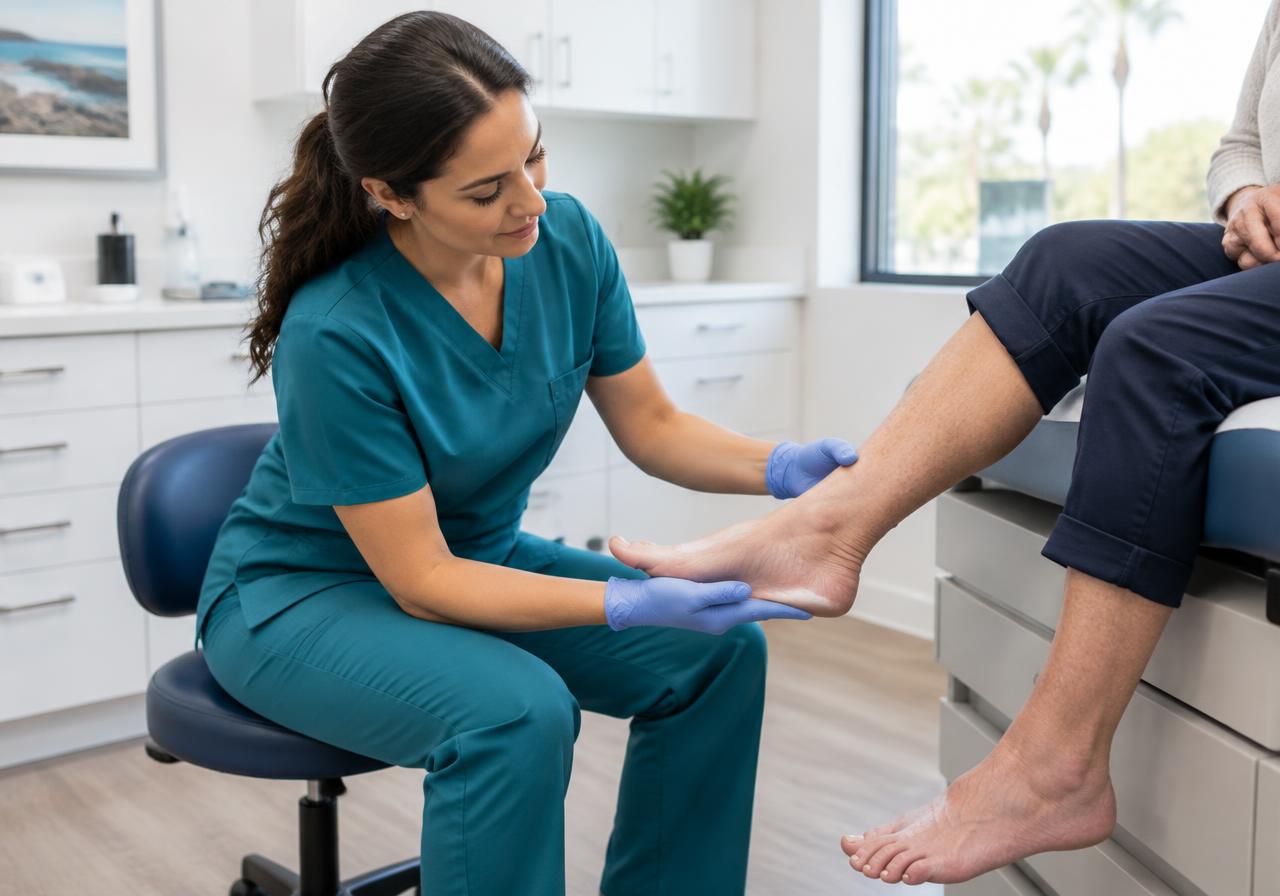
Built around foot and ankle care
The Documentation Behind Every Foot-Care Claim
Routine care, wound treatment and surgery each require a different billing review. The clinical note is where that review begins.
Our Podiatry Medical Billing Services, End to End
California Billing Services manages the podiatry revenue cycle, or the specific pieces your team wants support with.
| Service | What we do for your podiatry practice |
|---|---|
| Eligibility and benefits verification | Check active coverage, deductibles, podiatry and DME benefits, and prior authorization rules before the visit, including Medicare Advantage plans that differ from traditional Medicare. |
| Podiatry coding and charge entry | Assign CPT, HCPCS and ICD-10-CM codes from the provider's note, apply Q-, T-, LT/RT, 25, 59/XS and global-period modifiers, and flag documentation gaps for the provider. |
| Claim scrubbing and submission | Run claims against NCCI edits, MUEs, payer rules and LCD frequency limits before electronic submission. |
| Payment posting | Post ERAs and EOBs line by line, identify underpayments against your fee schedule, and post patient responsibility correctly. |
| Denial management and appeals | Work every denial by root cause, correct and resubmit, and file redeterminations and payer appeals with supporting records. |
| A/R follow-up | Follow up on unpaid claims by aging bucket, with priority on high-dollar surgical and DME claims. |
| DME and DMEPOS billing | Bill therapeutic shoes, inserts and other foot and ankle DME to the correct DME MAC or commercial payer, with KX and documentation requirements met. |
| Credentialing and enrollment | Enroll DPMs with Medicare (PECOS), Medicaid and commercial plans, maintain CAQH, and handle DMEPOS supplier enrollment support. |
| Patient billing | Clear statements, payment plans and a patient-facing billing line. |
| Reporting and RCM analytics | Monthly reports on collections, denial rate by reason, days in A/R, and payer mix. |
Need only coding, or only A/R cleanup? We also offer podiatry billing and coding services as standalone engagements.
Podiatry Coding Expertise Where Claims Usually Fail
Correct coding starts with the note. Our coders read the provider's documentation, assign codes that match it, and send gaps back to the provider before the claim goes out. We never code services that aren't documented.
Routine foot care and class findings
Medicare excludes routine foot care under Social Security Act §1862(a)(13). CMS Benefit Policy Manual Chapter 15, §290 and your MAC's routine foot care LCD set the exceptions. We check each claim for:
A qualifying systemic condition, such as diabetes mellitus, peripheral arterial disease or peripheral neuropathy, coded to full ICD-10-CM specificity.
Documented class findings and the matching modifier: Q7 (one Class A finding), Q8 (two Class B findings) or Q9 (one Class B and two Class C findings).
The name or NPI of the treating MD or DO and the date the patient was last seen, when the condition requires active medical management (for example, diabetes or certain neuropathies).
Frequency limits are checked against the applicable payer policy and current LCD.
The right liability modifier when care isn't covered: GY for statutorily excluded services, GA when a valid ABN is on file for expected denials.
Nail and skin procedures
We code paring of corns and calluses (CPT 11055–11057), debridement of nails (11720 for one to five, 11721 for six or more), nail avulsion (11730, with add-on 11732), and matrixectomy (11750). For mycotic nails (B35.1), we confirm the note shows pain, secondary infection, or limited ambulation, or that class findings support coverage.
Wound care and diabetic foot ulcers
Debridement is coded by depth and surface area: 11042–11044 for subcutaneous tissue, muscle or fascia, and bone, with add-ons 11045–11047 for each additional 20 sq cm. Selective debridement uses 97597 and 97598. Diabetic foot ulcers are coded with E11.621 plus the L97.4- or L97.5- code for site, laterality and depth. Skin substitute application (15275–15278) and the product's HCPCS Q-code get an extra documentation check, since MACs review these closely.
Foot and ankle surgery and global periods
Bunion correction (28292–28299 range), hammertoe repair (28285), and most other foot surgeries carry a 90-day global period. We track globals so post-op visits aren't billed in error, and apply modifiers 24, 25, 57, 58, 78 and 79 when an unrelated or staged service is payable. For co-management, we split care with 54 and 55.
Injections, imaging and E/M
We code tendon sheath and joint injections (20550, 20600), Morton's neuroma injections (64455), drugs by HCPCS J-code and units, and in-office X-rays (73620, 73630). E/M levels follow the 2021 AMA guidelines based on medical decision making or time, and modifier 25 is used only when the note supports a separate service.
DME, diabetic shoes and orthotics
Therapeutic shoes and inserts for diabetic patients (A5500, A5512, A5513) are billed to the DME MAC under your DMEPOS supplier number with the KX modifier. The certifying physician must be the MD or DO managing the patient's diabetes, and we track that statement, the prescription and the fitting documentation. Custom foot orthotics (such as L3000) are generally excluded by Medicare unless part of a leg brace or the diabetic shoe benefit, so we verify commercial coverage and set patient expectations early.
Toe and laterality modifiers
TA and T1–T4 identify the left great toe through fifth toe; T5 and T6–T9 identify the right. Combined with LT/RT and XS, these keep multi-toe procedures from colliding with NCCI edits.
Explore our medical coding services and orthopedic billing.
Code and payer references are a guide, not a coverage guarantee. Confirm the current code set, applicable LCD and case-specific documentation before billing.
Common Podiatry Denials and How We Prevent Them
Most podiatry denials trace back to a short list of causes. We fix the claim in front of us, then fix the process that produced it.
| Denial (common CARC) | Typical podiatry cause | How we prevent it |
|---|---|---|
| CO-96 / CO-204: non-covered service | Routine foot care billed without class findings or a qualifying condition | Pre-bill check for diagnosis, class findings and Q-modifier; GY or GA applied when coverage isn't expected |
| CO-50: not medically necessary | Mycotic nail or callus care without documented symptoms | Coder queries the provider for pain, infection or ambulation limits before submission |
| CO-16: missing information | Missing MD/DO name, NPI or date last seen | Required claim fields captured at check-in and verified at charge entry |
| CO-4: modifier inconsistent | Wrong or missing T-, LT/RT or Q-modifier | Modifier rules built into our scrubber by payer |
| CO-97: bundled | E/M without valid modifier 25, or procedures that hit NCCI edits | NCCI and MUE review; 25 and XS used only when the note supports them |
| CO-119 / CO-151: frequency exceeded | Routine care or debridement billed sooner than the LCD allows | Last-service-date tracking per patient |
| CO-197: no prior authorization | Surgery or DME for Medicare Advantage or commercial plans | Auth requirements checked during eligibility verification |
| CO-11: diagnosis inconsistent | Unspecified ulcer or diabetes codes | ICD-10-CM coded to full specificity for site, laterality and depth |
| CO-29: timely filing | Claims held for documentation | Daily charge lag report and provider follow-up |
Outsourcing Podiatry Billing vs. Keeping It In-House
Outsourcing podiatry billing makes sense when denials, A/R days or staff turnover are costing more than a billing partner would. It makes less sense if your in-house team already knows podiatry rules and has the time to work every denial.
| Factor | In-house billing | Outsourced podiatry billing with California Billing Services |
|---|---|---|
| Cost structure | Salaries, benefits, software, training, coverage for time off | Practice-specific quote; confirm fee structure and inclusions |
| Podiatry rule knowledge | Depends on one or two people | Team of coders who work podiatry claims daily |
| Coverage during turnover | Billing slows or stops | Agree on staffing coverage and transition responsibilities |
| Denial follow-up | Low-dollar denials often written off | Every denial worked by root cause |
| Regulatory updates | Staff must track LCD, CPT and NCCI changes | Review how code and payer-rule updates are maintained |
| Visibility | Varies | Agree on reporting frequency and a billing contact |
You keep your EHR, your payer contracts and full access to your data. When you outsource podiatry billing services to us, we work inside your existing practice management system wherever possible.
Podiatry Practices We Support
We build the billing workflow around how your practice actually sees patients:
Solo DPM practices that need a full billing department without hiring one.
Multi-provider and multi-location podiatry groups that need consistent coding and reporting across sites.
Wound care–focused practices with high volumes of debridement, skin substitutes and diabetic foot care.
Surgical podiatry practices billing hospital, ASC and in-office procedures with global period tracking.
Practices dispensing DME, including diabetic shoes, inserts, braces and walking boots.
Practices with nursing home or home visit patients, where routine foot care rules and place-of-service coding matter most.
Podiatry billing services across the USA
Our team is based in San Diego. For practices outside California, discuss your Medicare contractor, Medicaid program and payer requirements with us to confirm the scope of support.
Systems: Discuss access and workflow compatibility for athenahealth, eClinicalWorks, AdvancedMD, DrChrono, NextGen Healthcare or Tebra during your practice review.
Podiatry Billing Services for California Practices
California podiatry billing runs on rules that out-of-state billing companies often miss. Delegated IPAs pay many HMO claims, Medi-Cal is split across fee-for-service and more than a dozen managed care plans, and Medicare pays at different rates across the state's payment localities. California Billing Services is headquartered in San Diego, and California payers are our home market.
California payers we bill for podiatry
| Payer type | Key payers | What matters for podiatry claims |
|---|---|---|
| Medicare Part B | Noridian Healthcare Solutions (Jurisdiction E) | Noridian's routine foot care LCD, Q7–Q9 class findings, and locality-specific fee schedules |
| Medicare DME | Noridian (DME MAC Jurisdiction D) | Diabetic shoes and inserts (A5500, A5512, A5513), KX modifier, certifying physician statement |
| Medi-Cal fee-for-service | California Department of Health Care Services (DHCS) | DPM enrollment through PAVE, Treatment Authorization Requests (TARs) where required, Medi-Cal podiatry benefit limits |
| Medi-Cal managed care | L.A. Care Health Plan, Health Net, Inland Empire Health Plan (IEHP), CalOptima Health, Partnership HealthPlan of California, Molina Healthcare, Anthem Blue Cross, Alameda Alliance for Health, Santa Clara Family Health Plan, CalViva Health, Kern Health Systems | Each plan, or its delegated IPA, sets its own referral, authorization and claims rules |
| Medicare Advantage | Kaiser Permanente Senior Advantage, SCAN Health Plan, Alignment Health, UnitedHealthcare, Humana, Anthem, Blue Shield | Prior authorization for surgery and DME; many claims route to a medical group, not the plan |
| Commercial | Blue Shield of California, Anthem Blue Cross, Health Net, Aetna, Cigna, UnitedHealthcare | HMO vs. PPO routing, orthotics benefits that vary by plan, contracted rate checks |
| Workers' compensation | State Compensation Insurance Fund (State Fund), private carriers and TPAs | DWC Official Medical Fee Schedule (OMFS), Requests for Authorization (RFA), utilization review, second bill review and Independent Bill Review (IBR) |
California rules that change how podiatry claims get paid
Delegated IPAs and medical groups. Many HMO, Medicare Advantage and Medi-Cal managed care patients are assigned to an IPA that pays claims instead of the health plan. We confirm the financially responsible payer at eligibility, because a claim sent to the wrong entity is one of the most common California denials.
Medi-Medi crossovers. For patients with both Medicare and Medi-Cal, we confirm claims cross over from Noridian and follow up on the Medi-Cal secondary payment.
Medicare payment localities. Reimbursement varies by locality. Review the applicable fee schedule when checking payments and potential underpayments.
Prompt-pay and dispute rights. Under the Knox-Keene Act and the California Insurance Code, plans must pay clean claims on time or owe interest. We track late payments, request interest due, and file Provider Dispute Resolution (PDR) requests, escalating to the DMHC or CDI when a plan doesn't resolve them.
Podiatry billing across California cities
Discuss your county, existing EHR and remote billing workflow with our team.
Southern California: Los Angeles · San Diego · Long Beach · Irvine · Anaheim · Riverside · Santa Ana · San Bernardino · Pasadena · Torrance · Glendale · Chula Vista · Temecula · Palm Springs
Bay Area and Northern California: San Francisco · San Jose · Oakland · Sacramento · Fremont · Walnut Creek · Santa Rosa · Stockton · Redding
Central Valley and Central Coast: Fresno · Bakersfield · Modesto · Visalia · Salinas · San Luis Obispo · Santa Barbara · Oxnard
Code and payer references are a guide, not a coverage guarantee. Confirm the current code set, applicable LCD and case-specific documentation before billing.
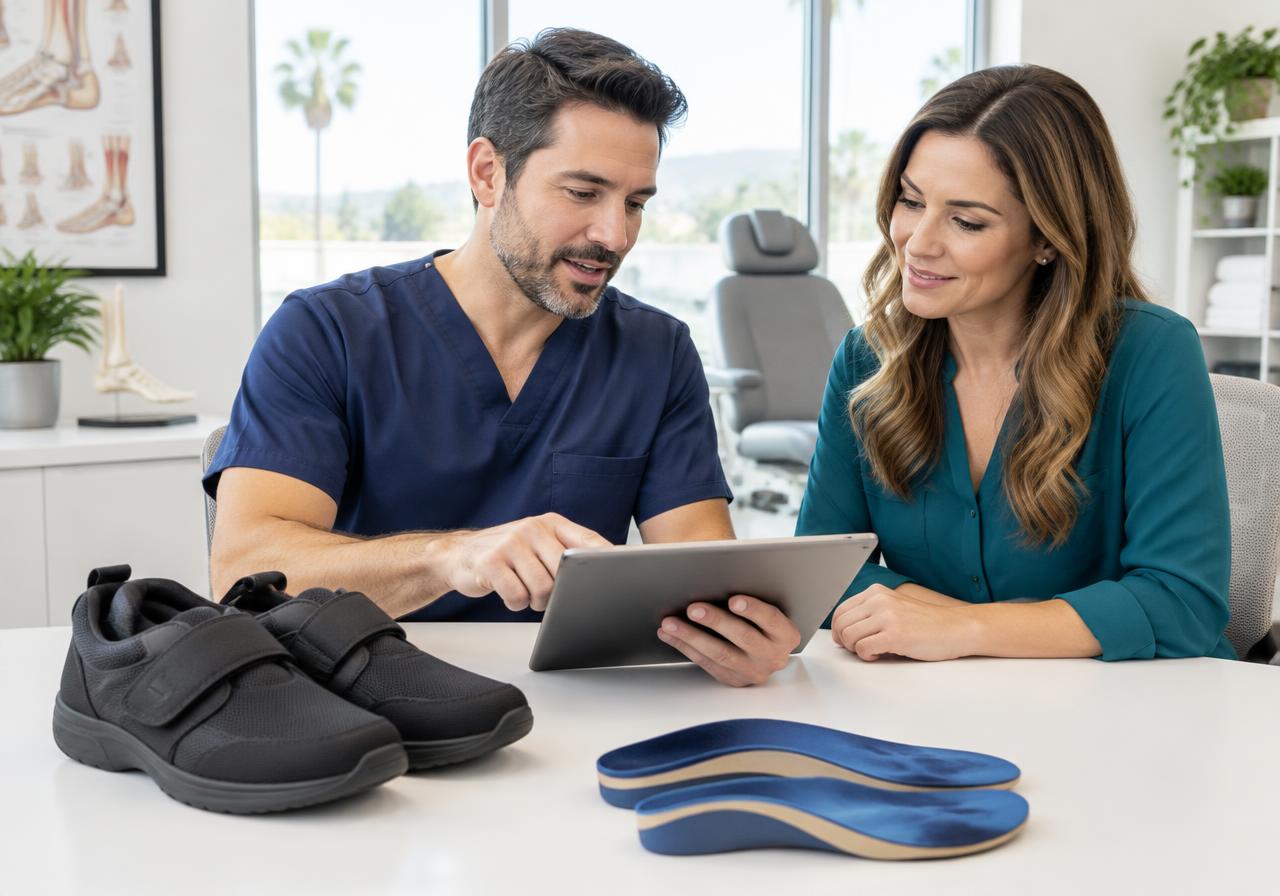
Connected clinical and billing workflows
From the Care Plan to the Claim
Foot and ankle procedures, therapeutic shoes and orthotics need the right documentation and payer routing.
How Onboarding Works
Onboarding timing depends on system access, payer enrollment and practice requirements. Review EFT and ERA changes alongside the transition plan.
Podiatry billing review. Review claims, denials and A/R to identify where revenue may be leaking.
Agreement and BAA. Review the service agreement, Business Associate Agreement and patient-data handling requirements.
System access and payer setup. We connect to your EHR/PM system, clearinghouse and payer portals, and confirm enrollment and DMEPOS status.
Workflow and fee schedule review. We map your visit types, check-in process and fee schedule, and set podiatry-specific scrubber rules.
Go-live. Confirm responsibility for charge entry, submission, posting, follow-up and existing A/R before the transition.
Reporting review. Agree on the KPI report, review schedule and billing contact.
Compliance, Security and Reporting You Can Check
Podiatry is a frequent focus of Medicare reviews, especially routine foot care, nail debridement and wound care. Our process is designed to hold up when a payer asks for records.
Coding compliance: We code only what is documented, follow CPT, ICD-10-CM and HCPCS guidelines, NCCI edits and your MAC's LCDs, and query providers instead of guessing.
Audit readiness: Review the coding audit process, sampling schedule and provider feedback requirements.
HIPAA and data security: Review the BAA, role-based access, data-transfer safeguards and staff training before granting system access.
Transparent reporting: Review collections, net collection rate, denial reasons, days in A/R and charge lag with an agreed reporting schedule.
You always own your data and can see the status of any claim.
How to Choose the Best Podiatry Billing Services for Your Practice
The best podiatry billing company for you is the one that can prove it understands podiatry, not just medical billing. Ask any vendor, including us, these questions:
How do you handle routine foot care claims, and when do you apply Q7, Q8, Q9, GY or GA?
Who codes our claims, what credentials do they hold, and how much of their work is podiatry?
Can you bill diabetic shoes and inserts to the DME MAC, and do you track the certifying physician statement?
How do you track 90-day global periods for foot surgery?
What is your denial rate and net collection rate for podiatry clients, and how is it measured?
What do you charge, what's included, and what costs extra (credentialing, old A/R, patient statements)?
What happens to our data and A/R if we leave?
Discuss these questions with our team during your practice review.
Podiatry Billing Services FAQs
Podiatry billing services cover eligibility checks, coding, charge entry, claim submission, payment posting, denial management, A/R follow-up and reporting. At California Billing Services, they also include DME billing and credentialing support for DPMs.
Can't find what you're looking for? Contact our billing specialists
Get Paid for the Foot Care You Already Provide
Your patients’ feet are your focus. Discuss your claims, denials and billing workflow with California Billing Services to understand what is being denied and where a closer review may help.
600 W Broadway, Suite 700, San Diego, CA 92101