


01
Eligibility Missed at Walk-In
No appointment leaves little time to verify. Inactive coverage, the wrong plan or an HMO member assigned to another medical group can turn into a denial weeks later. We review coverage and assignment at check-in.
Urgent care billing services built for walk-in volume: eligibility, coding, global-fee and fee-for-service contracts, workers' comp and self-pay collections, handled by one team focused on California payers.
Every walk-in visit deserves a complete, accurate claim.
Urgent care runs on volume, so small front-desk and billing errors can repeat across many claims. These are the five leaks we review first.
No appointment leaves little time to verify. Inactive coverage, the wrong plan or an HMO member assigned to another medical group can turn into a denial weeks later. We review coverage and assignment at check-in.
Some payers pay a flat S9083 rate per visit; others pay line by line. Billing the wrong way can lead to underpayment or denial. Each claim needs to match its payer contract.
A visit with a laceration repair, X-ray and strep test needs a review of every supported billable service. We capture procedures, interpretations, tests and injections, with modifier 25 only when a separate E/M is documented and allowed.
Injured-worker visits need the employer's carrier, applicable fee schedule and required reports. We route them separately so they do not sit in a commercial billing queue.
Once the patient leaves, balances can be harder to collect. Point-of-service workflows, posted self-pay prices and clear statements keep patient responsibility visible.
Find your biggest revenue leak with a urgent-care billing review.
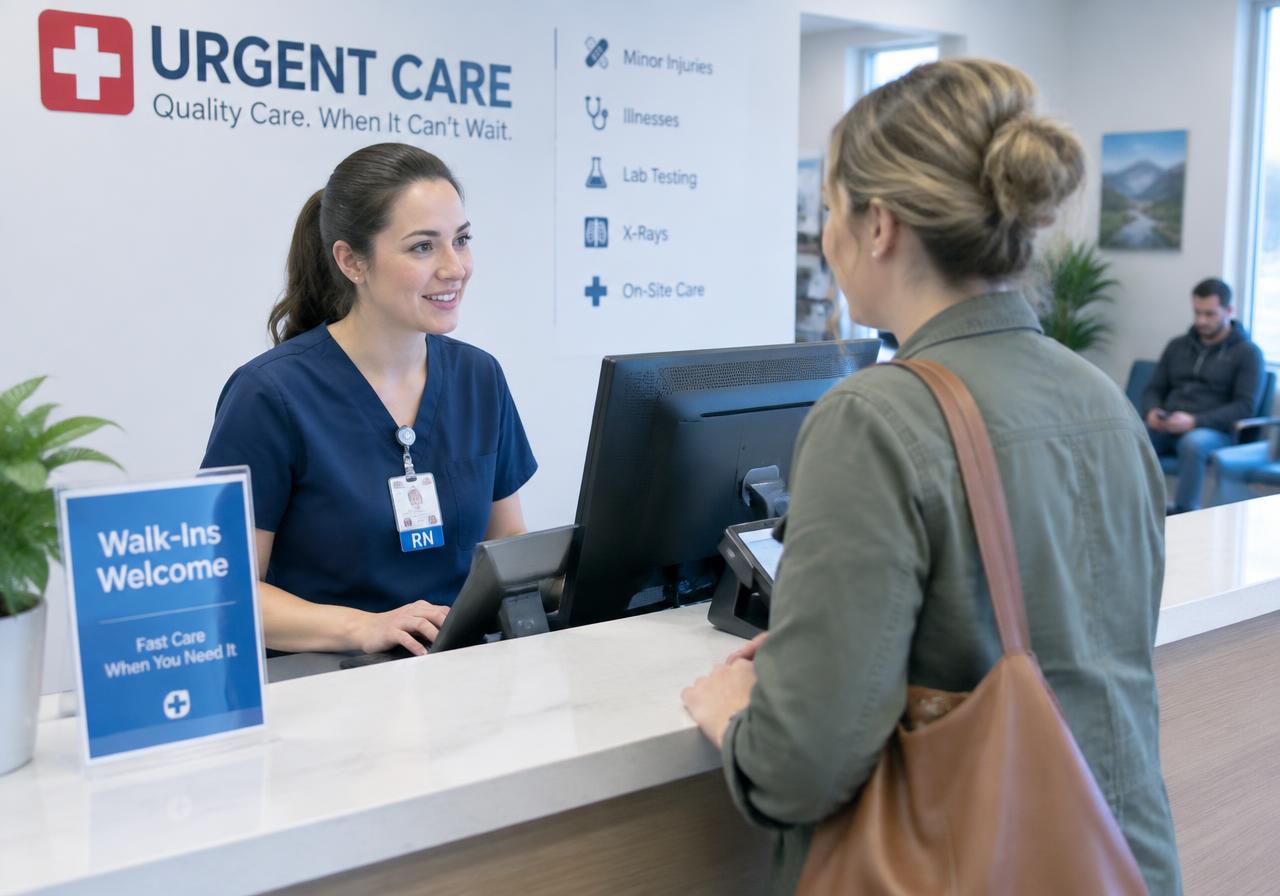
Built around your care
Your team focuses on walk-in, injury and workers' comp visits. We handle the claims, payer follow-up and documentation questions behind them, so urgent care centers can spend less time chasing payments.
One accountable team from check-in to final payment.
Coverage, copay, deductible and HMO medical-group assignment reviewed for walk-in visits.
Explore serviceE/M, procedures, X-rays, labs and injections coded from the visit note.
Explore serviceSupported billable lines captured; NCCI, payer and contract edits checked before submission.
Global-fee (S9083) and fee-for-service claims reviewed against each payer's contract.
Carrier claims, required reports and employer invoices handled on separate tracks.
Payments checked against contracted rates to identify underpayments.
Denials worked by root cause and applicable appeal deadline.
Explore serviceOpen claims prioritized by value, with old AR recovery scoped separately.
Explore serviceGroup and provider enrollment for new centers, new locations and locum providers.
Explore serviceStatements, payment plans and self-pay follow-up coordinated with your front desk.
Charge-entry and submission workflows designed around busy weekends and walk-in demand, with turnaround agreed before go-live.
Commercial, Medicare, Medi-Cal, workers' comp, employer and self-pay workflows coordinated with separate rules for each.
Global-fee and fee-for-service contracts reviewed alongside payment posting to flag underpaid visits.
California-focused review of Medi-Cal plans, IPA assignments and workers' compensation billing requirements.
Visits, revenue per visit, payer mix, denials and point-of-service collections reviewed by location.
Discuss a quote based on locations, visit volume and service scope, with included fees and exit terms agreed in writing.
Minor illness, minor injury, testing and treatment, coded from the visit note.
New and established visits (99202–99215) reviewed using the applicable E/M criteria. After-hours codes such as 99051 and 99050 depend on commercial payer coverage; Medicare generally bundles these add-ons.
Laceration repair, incision and drainage (10060/10061), foreign body removal, splinting, strapping, nail removal (11730) and burn care reviewed against the documented technique, site and current code set. Modifier 25 requires a separately supported E/M.
Chest (71045–71048) and extremity imaging reviewed for global billing or professional and technical components (26 / TC), according to who performed and interpreted the service.
Strep (87880), flu (87804), COVID-19 testing, urinalysis, glucose and venipuncture coded to the actual test and method. QW is used only when required for the specific waived test and your CLIA status supports it.
Therapeutic injections (96372), supported drug J-codes, IV hydration (96360/96361), nebulizer treatments (94640) and vaccine administration reviewed for dose, time, documentation and coverage.
Video and audio services reviewed under each payer's current telehealth rules, including applicable POS 02 or 10 and modifiers such as 95 when required.
Injury diagnoses are reviewed for the appropriate encounter character and external-cause detail, including work-related injuries when documented.
How an urgent care claim is built depends on where it is billed from and what the contract says.
Freestanding urgent care professional claims generally use POS 20, distinct from an office or emergency department. Hybrid clinics and hospital-based services need setting-specific review, including separate facility billing when applicable.
Some commercial contracts pay one urgent care case rate using S9083, with S9088 only where contract terms support it. Others pay each CPT line. Medicare does not recognize these S-codes for payment. Check carve-outs and contracted reimbursement before submission.
| Contract type | How it is billed | Common mistake |
|---|---|---|
| Global fee (S9083) | Contracted case rate per visit, with applicable carve-outs | Submitting separate CPT lines when the contract requires a case rate |
| Fee-for-service | Supported E/M, procedure, imaging and lab lines | Using S9083 when the contract reimburses individual services |
| Medicare | Covered CPT/HCPCS under applicable Medicare rules | Submitting S-codes or expecting separate after-hours payment |
Work injuries follow California workers' compensation rules, not your commercial contracts.
For injuries referred to specialist care, explore orthopedic billing.
Collection workflows that keep your front desk and billing team aligned.
Contract terms, medical-group assignments and claim routing reviewed for California centers.
Review urgent care contract terms for Anthem Blue Cross, Blue Shield of California, Health Net, Aetna, UnitedHealthcare, Cigna and Covered California plans. Confirm your specific payer arrangements with our team.
Check medical-group assignment and Division of Financial Responsibility (DOFR) where applicable, so claims reach the financially responsible payer.
Review Noridian JE requirements, NP and PA billing arrangements and plan-specific Medicare Advantage rules for walk-in care.
Review applicable prompt-pay, interest and dispute requirements, with DMHC or Department of Insurance escalation considered according to plan jurisdiction.
Review Medi-Cal, IPA, workers’ comp and self-pay workflows under one roof.
Billing performance reviewed by location, payer and visit type.
First-pass claims accepted without corrections.
Denials grouped by payer, location and root cause.
Time between billing and collection, reviewed month by month.
Aged balances prioritized for follow-up and resolution.
Collections measured against collectible revenue.
| Modifier | Use in urgent care |
|---|---|
| 25 | Significant, separately identifiable E/M on the day of a procedure or injection |
| 59 / XS | Distinct service or anatomic site when documentation and NCCI rules support separate billing |
| 26 / TC | Professional interpretation / technical component, when applicable |
| QW | Applicable CLIA-waived test when the specific code requires it |
| 76 / 77 | Repeat procedure by the same / another qualified provider when supported |
| 95 | Synchronous telehealth when the payer requires this modifier |
Modifier selection follows the documented visit, procedure, test method and applicable payer edits.
A coordinated billing team without building an in-house department.
Centralized billing with reporting by site.
Workers' comp, employer services and DOT exam billing workflows.
Scheduled and walk-in visits reviewed for the correct place of service.
Billing support for high-volume Medi-Cal and commercial pediatric visits.
Credentialing and payer setup coordinated around your opening plans.
For hybrid clinics, see family medicine billing.

A team that knows your specialty
Coders and billers familiar with urgent care workflows review every claim before it goes out and keep you updated with clear monthly reporting.
Agree on a transition schedule with prior AR worked alongside new claims.
Review claims, denials, contracts and AR to identify revenue gaps.
Agree on BAA requirements, EMR access and payer-portal access for every location.
Prepare global-fee and fee-for-service rates for the relevant payers.
Coordinate new claims and prior AR work during the handover.
Agree on charge-entry, claim-submission and front-desk collection workflows.
Review visits, revenue per visit, denials and AR by location.
Pricing is scoped by locations and visit volume, reflecting providers who rotate across shifts and sites. Confirm your rate, included fees and terms with our team.
Practice-specific quote
Practice-specific quote
Practice-specific quote
Opening a new center? Discuss credentialing, payer enrollment and billing setup, with old AR recovery scoped separately.
| Model | How it works | Best for |
|---|---|---|
| Percentage of collections | An agreed percentage of payments received; confirm the collection base and exclusions | Centers seeking a collections-linked arrangement |
| Flat per-visit | An agreed fixed fee per billed visit | High-volume case-rate centers seeking a predictable visit cost |
| Hybrid | An agreed percentage plus a per-visit fee | Groups with mixed case-rate and fee-for-service payers |
Confirm eligibility checks, coding, claim submission, clearinghouse fees, payment posting, denial and appeal work, patient statements and reporting. Agree on any additional charges, contract term and exit provisions before signing.
Compare your proposed fee against actual collections, eligibility denials, missed charges and contract underpayments. A review of your own center's numbers can help you judge the arrangement without assuming a guaranteed revenue increase.
Discuss all seven questions with our team before you sign.
| Consideration | In-house billing team | California Billing Services |
|---|---|---|
| Cost | Billers, coders, software and clearinghouse | Center-specific quote with agreed fees |
| Weekend and seasonal surges | Coverage depends on staffing capacity | Volume-aware workflow and submission planning |
| Contract enforcement | Depends on internal review processes | Contract-aware payment review |
| Workers' comp expertise | Depends on hiring and training | Separate California-focused workflow |
| Reporting by location | Depends on reporting tools and staff | Location-level reporting scope agreed at setup |
Discuss access to your existing system and confirm compatibility before your transition.
Plus Orange County, the Inland Empire and the Central Valley.
HIPAA and CMIA-aligned data handling, a Business Associate Agreement and controlled access are central to billing setup. Review role-based access, encryption and audit-trail requirements with our team before sharing practice data, including visit notes, X-ray reads and lab results.
Pricing depends on locations, visit volume, payer contracts and service scope. Discuss percentage-of-collections, per-visit and hybrid options with our team, and confirm included fees and contract terms in your quote.
Can't find what you're looking for? Contact our billing specialists
Review eligibility denials, contract underpayments, missed procedure and lab lines, workers’ comp delays and aging AR with our team. Discuss the scope of your urgent care billing audit before sharing claims.