


Anesthesia billing & RCM · California

Anesthesia Billing Services in California

California Billing Services provides anesthesia billing services for anesthesiologists, CRNAs, ambulatory surgery centers and hospital anesthesia departments across California. Our anesthesia coders capture every base unit, time unit and modifier, apply the right medical direction and CRNA modifiers, and collect from Medicare, Medi-Cal, commercial, workers' compensation and out-of-network payers. You get paid for every minute of anesthesia your team documents.

Share recent anesthesia claims and we can show you where revenue is being lost.

HIPAA safeguards and BAACoders trained in anesthesia and pain managementMedicare, Medi-Cal, commercial and workers' comp expertiseWork from your AIMS, EHR and practice management system

0 min

Minutes per Medicare anesthesia time unit, paid in fractions

0 rooms

Concurrency limit for medically directed (QK) cases

0%

AB 72 floor: out-of-network pay of at least 125% of Medicare

0 pts

2026 MIPS performance threshold

How it works

How billing for anesthesia services works

Anesthesia is paid by a formula, not a flat fee: base units plus time units plus modifying units, multiplied by a conversion factor. The base units reflect the procedure's complexity, the time units reflect how long the patient was under anesthesia care, and the conversion factor is a dollar amount set by each payer.

Here's a Medicare example. A case with 5 base units and 92 minutes of anesthesia time earns 6.13 time units, for 11.13 total units. At the 2026 national Medicare anesthesia conversion factor of $20.4976, that case pays about $228 before the California locality adjustment. Round 92 minutes down to 6 units, or bill the wrong base units, and the practice loses money on a case it delivered in full. Across thousands of cases a year, those small errors add up to a large share of collections.

Medicare example

Base units
5
Time units (92 min ÷ 15)
6.13
Total units
11.13
× 2026 Medicare CF
$20.4976
Payment (before locality)
≈ $228
Who we serve

Anesthesia billing for every California practice model

Anesthesia groups are organized in very different ways, and each model bills differently. California Billing Services sets up your billing around how your group actually works.

Independent anesthesiology groups and private practices

For private anesthesia practices that outsource billing, we manage the full revenue cycle, from case capture to the final patient balance. You get per-provider and per-facility reporting, contract underpayment tracking, and the data you need to negotiate better commercial rates.

Hospital-employed and hospital-contracted anesthesia groups

For hospital-based groups, we capture cases from the hospital's anesthesia record, reconcile them against the OR schedule, and track coverage and call against any hospital support agreement. We also manage facility-based MIPS scoring and the reports hospital administrators ask for.

CRNA groups

Because California opted out of Medicare's CRNA physician-supervision requirement, CRNAs can bill Medicare independently using the QZ modifier. We enroll CRNAs with each payer, bill QZ and QX cases correctly, and confirm each commercial plan's own policy on independent CRNA services.

Ambulatory surgery centers

We bill anesthesia for multispecialty ASCs, including GI, ophthalmology, orthopedic, pain and plastic surgery cases. High case volume, short procedures and MAC billing need careful time capture and modifier use, and we handle both.

Office-based and mobile anesthesia providers

We bill for mobile and office-based anesthesia providers working in dental, oral surgery, plastic surgery, GI and endoscopy offices. That includes medical billing for anesthesia in dental settings, separating insured and self-pay cases, and keeping documentation compliant for each site of service.

Pain management practices

We bill interventional pain procedures performed by anesthesiologists, including epidurals, nerve blocks and radiofrequency ablation, with the prior authorizations these procedures usually need.

Where revenue leaks

Where anesthesia groups lose revenue

Most anesthesia revenue is lost quietly. The claim is paid, just for less than the case earned. These are the gaps we find most often when we review anesthesia claims.

Rounded or missing time

Time rounded down to whole units, or a missing start or end time, cuts payment on every case.

Wrong crosswalk

Using the scheduled procedure instead of the operative report can assign the wrong anesthesia code and base units.

Mismatched care team modifiers

A QK claim for the anesthesiologist with no matching QX claim for the CRNA, or more than four concurrent rooms, triggers reductions and audit risk.

Unbilled pain blocks and lines

Postoperative pain blocks, arterial lines and central lines are often left off the claim or lost to bundling edits.

Unpaid modifying units

Physical status and qualifying circumstance units go unbilled on commercial plans that pay them.

Underpayments nobody checks

Payments below the contracted conversion factor are posted without review.

Out-of-network claims paid at the wrong rate

Claims covered by AB 72 or the No Surprises Act are accepted at low initial payments when they could be disputed.

Medical coding

Anesthesia billing and coding services

California Billing Services codes every case from the full anesthesia record and operative report, not the surgical schedule. Accurate coding is where anesthesia revenue is won or lost.

Anesthesia time documentation and time units

We capture anesthesia time from the start of patient preparation for induction to the moment the patient is handed off for postanesthesia care, including discontinuous time when care is interrupted. Medicare claims report exact minutes and are paid on fractional units, and commercial claims follow each contract's unit and rounding rules.

Surgical crosswalks and base units

We crosswalk each surgical procedure to the correct anesthesia code (00100–01999) using the ASA Crosswalk and the operative report. Base units come from CMS for Medicare and from the ASA Relative Value Guide for commercial payers that use it.

Medical direction and concurrency

We check every medically directed case against the seven TEFRA requirements and the four-room concurrency limit, then apply QY, QK or AD to match. The anesthesiologist's and CRNA's claims are reconciled as a pair so both sides of the case are billed and paid.

CRNA billing

We bill CRNA services with QX when medically directed and QZ when not, under each CRNA's own NPI. Reassignment of benefits to your group is set up during enrollment so payments go to the right entity.

Monitored anesthesia care (MAC)

We bill MAC with the QS modifier, and add G8 or G9 when the procedure or the patient's condition supports it. Medical necessity is documented before the claim goes out, because MAC is a common target for denials.

Physical status and qualifying circumstances

We report physical status modifiers P1–P6 and qualifying circumstance codes 99100, 99116, 99135 and 99140 on every eligible case. Medicare doesn't pay these units, but many commercial plans do.

Separately billable procedures

We bill postoperative pain blocks (64415–64448, 64486–64489) when the surgeon requests them for postoperative pain, along with ultrasound guidance (76942), arterial lines (36620), central venous catheters (36556) and transesophageal echocardiography (93312, 93355). Each is documented separately from the anesthetic so it isn't bundled away.

Obstetric anesthesia

We bill labor epidurals (01967), cesarean add-ons (01968, 01969) and next-day epidural management (01996), following each payer's rules for labor time, which vary from actual minutes to flat units.

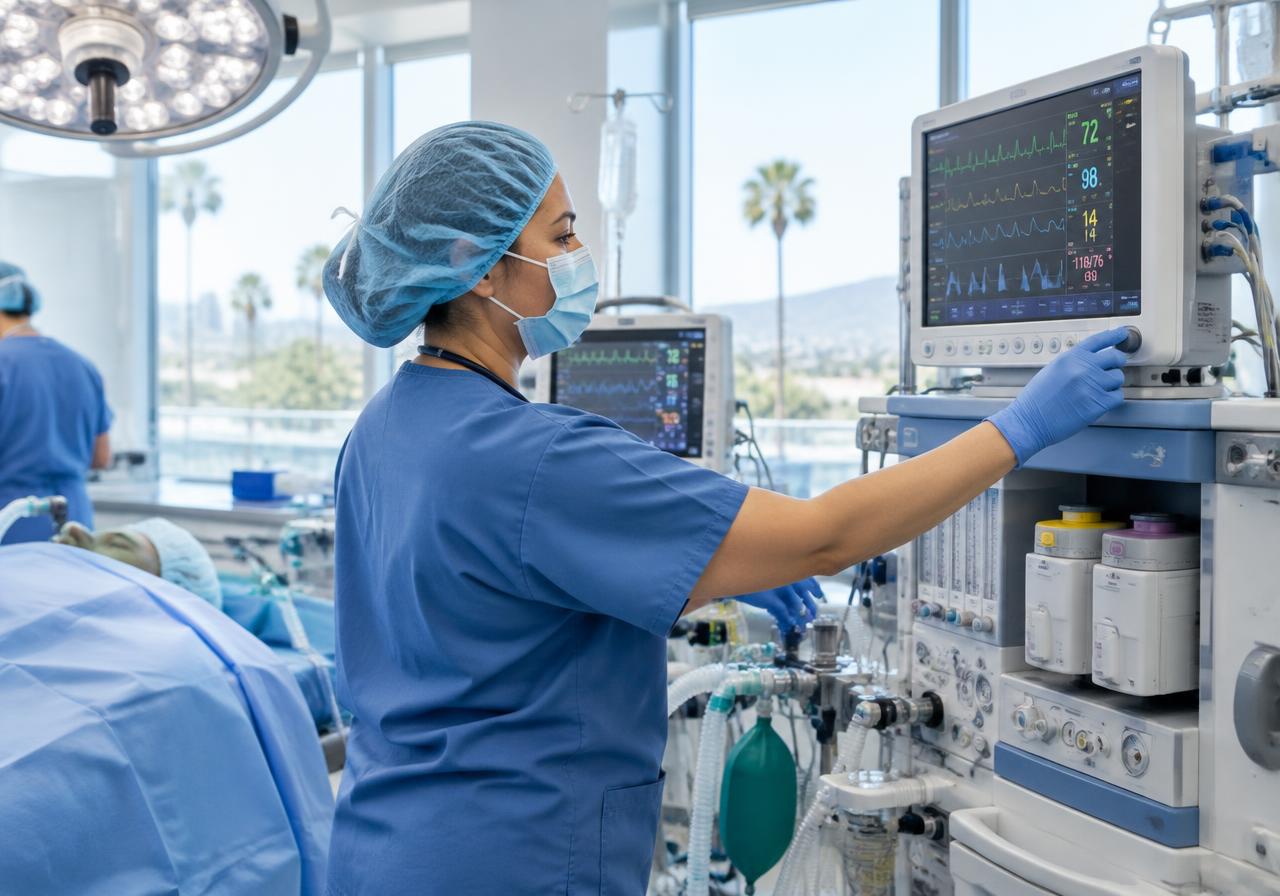
Anesthesia provider adjusting an anesthesia machine and patient monitor in a California operating room

Built around the anesthesia record

Every Minute and Modifier Captured

Start and stop times, care team modifiers, pain blocks and lines are billed from what your providers document, not from the surgical schedule.

Full revenue cycle

Anesthesia revenue cycle management services

California Billing Services manages the full anesthesia revenue cycle, from the day of surgery to the final payment. Choose end-to-end billing or only the services you need.

Case capture and charge reconciliation

We reconcile every anesthesia record against the facility's OR schedule and census each day, so no case is missed. Missing records, signatures and times are sent back to providers promptly.

Explore service

Insurance eligibility and benefits verification

We verify coverage for scheduled cases before the date of service, including Medi-Cal plan assignment, Medicare Advantage enrollment and secondary coverage. Patients get accurate cost estimates before surgery, not a surprise bill afterward.

Explore service

Prior authorization

We obtain authorizations for anesthesia and pain procedures that need them and confirm that the surgeon's authorization covers anesthesia where a plan requires it.

Explore service

Claim scrubbing and submission

Every claim is checked for crosswalk accuracy, time and unit math, care team modifiers, concurrency, NCCI edits and payer-specific rules before submission. Clean claims are sent electronically once the record is complete.

Payment posting and underpayment recovery

We post every payment line by line and compare it with your contracted conversion factor and unit rules. Underpaid claims are appealed, not written off.

Denial management and appeals

We sort denials by root cause, fix the source and appeal with the anesthesia record, operative report and medical necessity documentation. Medicare appeals go through Noridian, and commercial appeals follow each plan's process and deadlines.

Explore service

Accounts receivable follow-up

We work open claims by balance and age, and we take over aged AR from your previous biller during the transition.

Explore service

Credentialing and payer enrollment

We enroll anesthesiologists and CRNAs with Medicare through PECOS, Medi-Cal through PAVE and commercial plans through CAQH, and we keep revalidations and facility privileges current.

Explore service

Patient billing

Patients often don't expect a separate anesthesia bill. We send clear statements, answer billing questions, set up payment plans and prepare Good Faith Estimates for self-pay patients.

Reporting and analytics

Each month you get collections, total units and collections per unit, broken out by provider, facility, payer and procedure type, plus denial rate, days in AR and underpayments recovered.

Quality reporting

Detailed MIPS quality reporting for anesthesia

California Billing Services manages MIPS quality reporting for anesthesia groups, so Medicare payment adjustments work for you rather than against you. For 2026, the MIPS performance threshold is 75 points, and quality data must cover at least 75% of eligible cases.

We capture quality data at the time of billing, select the measures that fit your case mix and submit through claims, registry or a qualified clinical data registry such as ASA's NACOR. Common anesthesia measures include 430 and 463 for preventing postoperative nausea and vomiting and 477 for multimodal pain management. Measure 424, perioperative temperature management, was removed for 2026, so groups that relied on it need a new measure set. For hospital-based anesthesiologists, we also check whether facility-based scoring gives your group a better result.

0 pts

2026 performance threshold

0%

Minimum data completeness

0

PONV prevention measure (with 463)

0

Multimodal pain management

California payers

California anesthesia billing rules we handle every day

California has its own Medicare localities, the country's largest Medicaid program, a state surprise-billing law and a separate workers' comp fee schedule. Each one changes what an anesthesia claim should pay.

01

Medicare and Medicare Advantage

We bill Medicare through Noridian (Jurisdiction E), apply the anesthesia conversion factor for each California payment locality where your cases are performed, and follow Medicare's medical direction and teaching anesthesiologist rules. Medicare Advantage claims are checked against each plan's own anesthesia policy.

02

Medi-Cal

We bill Medi-Cal managed care plans and fee-for-service Medi-Cal, track Treatment Authorization Requests where needed, and confirm each member's plan before the date of service.

03

Commercial plans and AB 72

Under California's AB 72, an out-of-network anesthesia provider at an in-network facility is paid the greater of the plan's average contracted rate or 125% of Medicare, and can't balance-bill the patient. We check these payments against the required amount and use the state's dispute process when a plan pays too little.

04

No Surprises Act and independent dispute resolution

For self-funded employer plans and other plans regulated federally, the No Surprises Act applies instead. We manage open negotiation and independent dispute resolution (IDR) deadlines on underpaid out-of-network anesthesia claims.

05

Workers' compensation

We bill anesthesia for workers' comp cases under California's Official Medical Fee Schedule, which uses its own anesthesia conversion factor ($30.9437 for 2026, before locality adjustment). Bills are sent with the required reports, and underpayments go through second bill review.

Learn more
Choosing a partner

How to choose an anesthesia billing company

The best anesthesia billing services are the ones that know anesthesia's rules well enough to find money your current biller is missing. Ask any company you're considering these questions:

  1. 1Do you crosswalk cases from the operative report or the surgical schedule?
  2. 2How do you reconcile the QK and QX claims for the same case?
  3. 3Do you bill fractional time units to Medicare?
  4. 4Which of our commercial payers pay physical status and qualifying circumstance units?
  5. 5How do you handle AB 72 and No Surprises Act underpayments?
  6. 6How do you report MIPS quality measures for anesthesia?

California Billing Services can answer every one of these using your own claims.

Outsourcing anesthesia billing versus keeping it in-house

In-house billing teamCalifornia Billing Services
Anesthesia coding expertiseDepends on one or two hiresCoders trained in anesthesia
Staff turnoverBilling slows or stopsTeam-based coverage
Underpayment trackingRarely done line by lineEvery payment checked against contract
California laws (AB 72, CRNA opt-out, OMFS)Learned on the jobBuilt into our workflows
MIPS reportingOften a separate vendorIncluded
CostSalaries, benefits, software and trainingPercentage of collections
Step by step

How we take over your anesthesia billing

Cash flow continues throughout the switch.

  1. 0

    Claims review

    We review recent claims, payments and contracts and give you written findings.

  2. 0

    Setup

    We sign a BAA, connect to your AIMS and practice management system, and set up payer EDI, ERA and enrollment.

  3. 0

    Parallel billing

    We bill new cases while your current biller finishes its own, so cash flow doesn't stop.

  4. 0

    Full transition

    We take over all billing and start working your aged AR.

  5. 0

    Monthly review

    You get a performance report and a call to review results and next steps.

Results

Results you can measure

We report against industry benchmarks for anesthesia billing every month, so you always know how your revenue cycle is performing.

MetricIndustry benchmark
Clean claim rate95% or higher
Denial rateBelow 5%
Days in accounts receivableUnder 40 days
Net collection rate95% or higher
Charge lag2 days or less from a complete record
Compliance

Compliant, audit-ready anesthesia billing

Anesthesia is a frequent target of payer and OIG audits, especially medical direction, concurrency and time. California Billing Services bills so every claim can be defended.

  • Coders trained in anesthesia and pain management coding.
  • Medical direction claims checked against TEFRA requirements before billing.
  • Regular provider feedback on time, attestation and medical necessity documentation.
  • HIPAA-compliant systems, role-based access and encrypted data transfer.
Systems

Anesthesia billing inside the systems you already use

We work from the anesthesia record in your AIMS or EHR, including Epic Anesthesia, Oracle Health, Plexus TG and Shareable Ink, and from practice management systems such as athenahealth, AdvancedMD, NextGen and eClinicalWorks. When your system exports structured start and stop times, provider assignments and concurrency data, we use it directly, which removes manual re-entry and the time errors it causes.

Epic AnesthesiaOracle HealthPlexus TGShareable InkathenahealthAdvancedMDNextGeneClinicalWorks
Billing specialist reviewing anesthesia claim and payment reports on two monitors

Line-by-line follow-up

Every Payment Checked Against Your Contract

Collections per unit, underpayments and denials are reported by provider, facility and payer, so you can see exactly what's being recovered.

Pricing

Anesthesia billing pricing

Most anesthesia billing companies charge between 4% and 8% of net collections. Your rate depends on case volume, payer mix and the services you choose. Ask us for a quote based on your claims.

Locations

Anesthesia billing services across California

California Billing Services bills for anesthesia groups throughout California, working remotely in your systems.

Southern California

Los Angeles, Long Beach, Orange County, Irvine, Anaheim, San Diego, Riverside, San Bernardino and Ventura

Bay Area and Northern California

San Francisco, Oakland, San Jose, Santa Clara, Walnut Creek, Sacramento and Roseville

Central California

Fresno, Bakersfield, Modesto, Stockton and Visalia

See Los Angeles · San Diego · San Francisco · all locations.

FAQ

Anesthesia billing FAQs

Anesthesia billing services are the coding, claim submission and payment follow-up for anesthesia care provided by anesthesiologists and CRNAs. They include converting each case into base, time and modifying units, applying care team modifiers, submitting claims, posting payments, appealing denials and collecting patient balances. California Billing Services provides these services for anesthesia groups across California.

Can't find what you're looking for? Contact our billing specialists

Your next step

Find out what your anesthesia claims are leaving unpaid

Send us recent claims. We'll show you which time units, modifiers, procedures and underpayments are costing your group money and how we'd recover them.

Your information stays private and is never shared.

(631) 652-3106info@californiabillingservices.com