


01
Global period erosion
Post-operative visits, hardware removals and staged procedures billed without 58, 78 or 79 get absorbed into a surgery you were already paid for. Nothing is denied. The money simply never appears.
California Billing Services bills orthopedics in California and nothing else like it — Noridian Part B, Medi-Cal managed care, DWC workers' compensation, and the Covered California plans that bundle, downcode and quietly age your A/R past appeal.
Your surgeons earned the money. California's payers are sitting on it.
A single knee arthroscopy can carry four CPT codes, three modifiers, a laterality indicator, an implant invoice, a 90-day global period and a prior authorization that expires before the patient ever reaches the table. Get one element wrong and the claim does not bounce back loudly. It comes back quietly, as a reduced allowable you never notice, or it sits in a California bill review queue until the appeal clock runs out.
That is why orthopedic denial rates sit so far above the rest of medicine. MGMA benchmarking puts first-submission denials at 7% to 8% across physician practices generally, while orthopedic surgery practices with prior-authorization-heavy payer mixes are commonly estimated at 14% to 22% — driven by prior authorization for imaging, surgery and DME, implant bundling, and global period violations. California compounds every one of those drivers, because your practice is not billing one payer system. It is billing four, each with its own fee schedule, its own filing clock and its own appeal pathway.
First-submission denials
National physician average: 7–8% (MGMA) · Orthopedic surgery, prior-auth-heavy payer mix: 14–22% (estimated)
Post-operative visits, hardware removals and staged procedures billed without 58, 78 or 79 get absorbed into a surgery you were already paid for. Nothing is denied. The money simply never appears.
59 where XS was required. 51 where the payer wanted none. A missing LT or RT on a bilateral injection. Each one is a silent write-off, and each one compounds across every claim until somebody audits the pattern.
California DWC bills go out, come back short, and get filed instead of challenged. Second Bill Review and Independent Bill Review exist precisely to recover that difference, and most practices never use either.
Carelon, eviCore and Cohere approvals carry date windows. Surgery gets rescheduled. Nobody re-authorizes. The claim is denied on a technicality that was preventable the week before.
None of this is a staffing problem. It is a specialty-knowledge problem, and it costs a four-surgeon California practice six figures a year.
Not sure which leak is costing you most? An orthopedic billing review finds it.
Built around your care
Your team focuses on clinic, surgery, DME and therapy visits. We handle the claims, payer follow-up and documentation questions behind them, so orthopedic practices can spend less time chasing payments.
Orthopedic billing services in California are outsourced revenue cycle operations built specifically for musculoskeletal care, covering charge capture, surgical and E/M coding, prior authorization, claim submission, denial management and patient collections across four distinct California payer systems: Medicare Part B administered by Noridian Healthcare Solutions, Medi-Cal and its managed care plans, commercial and Covered California plans regulated by the DMHC or the Department of Insurance, and workers' compensation governed by the Division of Workers' Compensation.
A California orthopedic billing partner differs from a general medical billing company in three measurable ways: coders hold orthopedic-specific certification, the team bills under the DWC Official Medical Fee Schedule as routinely as it bills Medicare, and global surgical periods are tracked at the claim line rather than reconciled after the fact.
The work splits into front-end and back-end. Front-end decides whether you get paid. Back-end decides whether you get paid in full.
Eligibility and benefits verification, prior authorization with the payer's own delegate, surgical case costing, implant and hardware documentation, operative report coding, modifier assignment, NCCI edit resolution and claim scrubbing.
Clearinghouse rejection repair, payment posting against contracted rates, underpayment identification, denial appeal, Second Bill Review and Independent Bill Review for workers' compensation, A/R follow-up by aging bucket, and patient statements with a compliant good-faith estimate where the No Surprises Act applies.
The distinction that matters: a general billing company files your claim. An orthopedic billing company knows what your claim should have paid.
An orthopedic practice in Fresno and an orthopedic practice in Phoenix do not do the same job. California splits musculoskeletal reimbursement across four regulatory systems, and a claim that is perfect under one is defective under another. This is the single largest reason out-of-state billing companies underperform here.
| System | Who administers it | What it governs for orthopedics | The rule that catches practices out |
|---|---|---|---|
| Medicare Part B | Noridian Healthcare Solutions, MAC Jurisdiction JE | Fee-for-service Medicare, LCDs on injections, bracing and spinal procedures | Jurisdiction-specific coverage determinations and NCCI edits that bundle arthroscopic add-ons into the primary procedure |
| Medi-Cal and Medi-Cal managed care | DHCS, plus plan-level rules at L.A. Care, IEHP, CalOptima, Partnership HealthPlan, Health Net, Molina and others | Low-income and dual-eligible patients, pediatric orthopedics, CCS-eligible cases | A six-month filing window from the month of service, and authorization rules that differ from plan to plan within the same state |
| Commercial and Covered California | DMHC for HMO and most plan products, CDI for indemnity insurance | PPO, HMO and exchange plans, delegated prior authorization through Carelon, eviCore and Cohere | Knox-Keene prompt-pay obligations under AB 1455, and AB 72 balance-billing limits with their own dispute resolution process |
| Workers' compensation | Division of Workers' Compensation, Department of Industrial Relations | Industrial injuries: spine, shoulder, knee, hand, and the medical-legal work that follows them | Complete bills due within 12 months of service under Labor Code §4603.2, and a payment dispute that dies if it is not appealed on schedule |
Most practices handle Medicare competently, because Medicare is consistent and well documented. The losses concentrate in the other three. Medi-Cal managed care punishes a late or misrouted claim absolutely — miss the window and the money is gone, with no appeal that matters. Commercial plans in California delegate utilization management to third parties whose criteria are stricter than the plan's own policy, so an approval that looks valid in the portal can still be reversed at adjudication. And workers' compensation is where the largest recoverable balances sit.
We staff against each system separately. The person who files your Medi-Cal managed care claims is not the person who writes your DWC second review requests, because those are different disciplines wearing the same job title.
Not sure which of the four is costing you most? A billing review tells you.
If industrial injuries are even a quarter of your volume, workers' compensation is probably your largest single source of unrecovered revenue — not because claims are denied, but because they are reduced, and reductions are rarely challenged.
Here is the pattern. The bill goes out. The claims administrator applies its own bill review logic and issues an Explanation of Review paying less than the Official Medical Fee Schedule allows. The EOR looks official. Someone in the office posts it as a contractual adjustment and moves on. The difference is written off permanently, on every claim, every month. California gives you two formal chances to take that money back, and both have hard deadlines.
A request for second review must be filed within 90 days of receiving the initial Explanation of Review, on DWC Form SBR-1 for paper bills or as an electronic modified bill. Labor Code §4603.2(e)(2) releases the employer and the employee from liability for the disputed amount if the provider fails to file inside that window. Ninety days, and the claim is settled at whatever the payer decided it was worth.
If the only remaining dispute is the amount of payment and second review did not resolve it, the provider may request independent bill review within 30 calendar days of service of the second review determination. Miss that window and, under Labor Code §4603.6, the bill is deemed satisfied and no further payment is owed by anyone. The DWC designated Maximus Federal Services to conduct independent bill review.
Every workers' compensation EOR is reconciled line by line against the OMFS allowable on the date of service. Anything underpaid is queued for second review inside the 90-day window, not at the end of it. Anything still short after the second EOR goes to independent bill review inside 30 days. No EOR is posted as an adjustment until a human has confirmed the payment was actually correct.
DWC Form RFA prepared with the supporting documentation utilization review actually requires, not the minimum the form asks for. A denied RFA becomes a surgery that does not happen.
Tracking UR timelines, and preparing IMR submissions when treatment is denied.
Confirming MPN participation before treatment, because treating outside an employer's MPN is one of the cleanest grounds a payer has to refuse payment entirely.
California requires claims administrators to accept electronic bills under Labor Code §4603.4, and electronic submission carries a shorter payment clock than paper. We bill electronically with attachments properly linked, so the clock starts the day you file.
QME and AME reports billed under the medical-legal fee schedule, with the modifiers and record-review documentation those codes demand.
Lien filing and WCAB follow-through where a balance survives the bill review pathway.
A workers' compensation EOR is an opening position, not a verdict.
Send us 90 days of workers' comp EORs. We will tell you what was underpaid and what is still inside the appeal window.
We take the whole cycle or any segment of it. Most California practices start with coding and denials, then hand over the rest once the first quarter's numbers come back.
| Stage | What we do | What it protects |
|---|---|---|
| Eligibility and benefits | Verify coverage, deductible status, copay tier and orthopedic-specific benefit limits before the visit, including Medi-Cal managed care plan assignment | Front-desk collections and avoidable eligibility denials |
| Prior authorization | Submit and track authorizations through Carelon, eviCore, Cohere and plan portals; re-authorize when surgery dates move | Elective surgery revenue, imaging, DME and injectables |
| Charge capture | Reconcile the surgical schedule against billed charges daily, so no case is dropped between the OR log and the claim | Missed procedures, the most invisible loss in orthopedics |
| Surgical and E/M coding | CPT, ICD-10-CM and HCPCS by certified orthopedic coders; modifier assignment; NCCI and MUE edit resolution | Downcoding, bundling and modifier-driven underpayment |
| Global period management | Track 0, 10 and 90-day globals at the claim line; apply 24, 25, 57, 58, 78 and 79 where the documentation supports them | Post-operative work billed for free |
| Implant and hardware billing | Invoice-based implant billing, L-code DME, buy-and-bill injectables with correct NDC and units | Carve-out revenue and high-cost supply reimbursement |
| Claim submission | Scrub and transmit promptly after coding; payer-specific edits applied before submission | Days in A/R, and filing-deadline exposure |
| Payment posting | Post ERAs and EOBs against your contracted rates, not against billed charges | Underpayments that look like normal adjustments |
| Denial management | Root-cause every denial by CARC and RARC, appeal with clinical documentation, and feed the cause back into front-end rules | Repeat denials, and the appeal clock |
| A/R follow-up | Work every bucket on a schedule, oldest-at-risk first, with payer-level escalation | Claims aging past appeal and timely-filing limits |
| Patient billing | Statements, payment plans, card-on-file, and good-faith estimates where required | Patient balances, which are now a growing share of orthopedic revenue |
| Credentialing and enrollment | Payer enrollment, revalidation, CAQH maintenance and group roster updates | New hires billing from day one instead of month four |
| Reporting | Monthly dashboard: charges, collections, adjustments, denial rate by payer and by surgeon, A/R aging, net collection rate | Your ability to see the practice clearly |
Every item above is performed by named people assigned to your account. You will know who codes your cases and who works your denials, and you can talk to them.
Orthopedics is not one billing problem. A spine practice and a hand practice fail in completely different places. Here is where each one loses money, and what we watch.
| Subspecialty | Representative procedures | Where the revenue leaks |
|---|---|---|
| Sports medicine and arthroscopy | Knee and shoulder arthroscopy, meniscectomy, rotator cuff repair, ACL reconstruction | Add-on arthroscopic procedures bundled into the primary code by NCCI edits; wrong separate-procedure modifier |
| Joint replacement | Total and partial knee, hip and shoulder arthroplasty, revision arthroplasty | Prior authorization criteria from delegated reviewers, implant invoicing, and 90-day global periods swallowing related care |
| Spine surgery | Decompression, discectomy, laminectomy, fusion with instrumentation | Medical-necessity denials, levels billed without correct add-on sequencing, conservative-care documentation requirements |
| Hand, wrist and upper extremity | Carpal tunnel release, trigger finger, fracture fixation, tendon repair | Bilateral and digit-specific modifiers, and multiple-procedure reductions applied incorrectly |
| Foot, ankle and podiatric orthopedics | Bunion correction, ankle arthroscopy, Achilles repair, fracture care | Routine foot care exclusions, laterality errors, and DME dispensed without documented medical necessity |
| Trauma and fracture care | Open and closed reduction, internal and external fixation, hardware removal | Global package confusion between definitive fracture care and restorative treatment; hardware removal billed inside a global |
| Pediatric orthopedics | Scoliosis management, clubfoot, growth plate injuries, bracing | CCS authorization pathways and Medi-Cal plan-specific referral rules |
| Non-operative and interventional | Joint and tendon injections, ultrasound-guided injections, viscosupplementation | Drug units and NDC reporting, guidance billed separately when it is already included, series limits per joint per year |
| In-house ancillaries | Physical and occupational therapy, DME dispensing, X-ray and MRI | Therapy threshold documentation, DME supplier requirements, and technical and professional component splits |
| Ambulatory surgery centers | Orthopedic ASC facility billing | Facility and professional claims that must reconcile to each other, implant carve-outs, and out-of-network dispute pathways |
We code from the operative report, not from the scheduled procedure. Those two documents disagree more often than most practices realise, and the difference is usually in your favour — a lysis of adhesions performed but never billed, a second compartment addressed and never captured, an extended-service element documented and never coded.
Most practices do not have an overbilling problem. They have an underbilling habit.

A team that knows your specialty
Coders and billers familiar with orthopedic workflows review every claim before it goes out and keep you updated with clear monthly reporting.
The fear is reasonable. Every practice that has changed billing companies has a story about the quarter it cost them. The fix is a parallel run: we bill alongside your current process, reconcile daily, and only take full control once the numbers match.
Nothing is abandoned. Your legacy accounts receivable is worked from day six, in parallel with new claims, because the balances most likely to die are the ones already aging when the switch happens.
What we need from you: read-only system access, your payer contracts and fee schedules, a signed BAA, and one named person in your office who can answer questions in the first two weeks. That is the entire ask.
A/R and denial audit, payer mix mapped, BAA reviewed and signed.
System access set, fee schedules loaded, payer rules written.
We bill beside you, reconcile daily, and nothing is dropped.
We own the cycle, legacy A/R is worked, first dashboard delivered.
You keep your EHR. You keep your patient data. You keep your payer contracts. Nothing about how your practice runs clinically changes.
Billing companies quote results without definitions, which makes the results unfalsifiable. Here is what we measure, how each metric is calculated, and the published benchmark it is measured against. If you are already beating one of these, we will tell you in the audit rather than sell you a service you do not need.
| Metric | How it is calculated | Industry benchmark |
|---|---|---|
| First-pass clean claim rate | Claims accepted on first submission ÷ claims submitted | 95% is the commonly cited best-practice target |
| Initial denial rate | Claims denied on first adjudication ÷ claims submitted, by count | MGMA puts physician practices at 7–8%; orthopedic practices with heavy prior-auth exposure are commonly estimated at 14–22% |
| Days in A/R | Ending A/R ÷ average daily charges | Under 40 days is the widely cited orthopedic target |
| A/R over 90 days | Share of total A/R aged past 90 days | Under 15% is the common benchmark |
| Net collection rate | Payments ÷ (charges − contractual adjustments) | 95% or higher |
| Turnaround, encounter to claim | Business days from documentation complete to claim transmitted | Varies widely |
| Appeal rate on underpayments | Underpaid lines appealed ÷ underpaid lines identified | Rarely measured at all |
That last row is the one to read twice. Most practices measure denials and ignore underpayments, because an underpayment arrives looking like a payment. We reconcile every remittance against your contracted rate and the applicable fee schedule, and we appeal the difference. In California workers' compensation, that difference is often the largest recoverable number in the practice.
You get a monthly dashboard with charges, collections, adjustments, denial rate broken out by payer and by surgeon, A/R aging by bucket, and net collection rate. One scheduled call a month to walk through it. No request required.
See how your numbers compare against these benchmarks.
We log into your EHR and practice management system and bill from there. No data migration, no new software to buy, no retraining your front desk. If your system can grant a read-write billing role, we can work in it.
Epic, athenahealth, eClinicalWorks, NextGen, Modernizing Medicine, Exscribe, Medstrat, Nextech, Greenway, Veradigm, AdvancedMD, Tebra, CareCloud, DrChrono, and others. For ambulatory surgery centers: HST Pathways and Surgical Information Systems.
Availity, Waystar, Optum, Office Ally, TriZetto.
DaisyBill, Jopari, WorkCompEDI and P2P Link, submitting in the ASC X12 formats the DWC requires with attachments correctly linked to the bill.
If your system is not listed, ask. The answer is almost always yes, and we will tell you within a day if it is not. See how we work inside athenahealth, eClinicalWorks, AdvancedMD, DrChrono and Tebra.
Outsourced orthopedic billing in California is normally priced as a percentage of collections, typically in the mid single digits for a full revenue cycle engagement, with the exact rate set by monthly collections volume, payer mix and scope. Percentage pricing aligns the billing company's income with yours: we are paid on money that actually arrives, not on claims submitted.
| Model | How it works | Suits |
|---|---|---|
| Percentage of collections | A set percentage of what we collect for you, billed monthly | Most practices; the default, and the only model where our incentive matches yours |
| Flat fee per provider | A fixed monthly amount per rendering provider | Practices with stable, predictable volume that want a fixed line in the budget |
| Per-claim pricing | A set price per claim submitted and worked | High-volume, low-complexity service lines |
| Project engagement | Fixed scope and fixed price | Old A/R cleanup, a coding audit, a workers' compensation underpayment recovery project, credentialing backlogs |
Larger practices pay a lower percentage. This is the single biggest factor.
A practice at 40% workers' compensation takes more work per claim than one at 90% commercial, and the rate reflects it.
Coding and denials only, or the full cycle including patient billing and credentialing.
A clean A/R costs less to take over than one with eighteen months of untouched aging.
Get a rate quoted against your actual numbers.
We work remotely with practices statewide, and the regional differences are real. The payer mix in the Inland Empire is not the payer mix in Marin, and the workers' compensation exposure in the Central Valley is not the exposure in San Francisco. Each region below gets rules configured for the plans your patients actually carry.
| Region | Metros we serve | What shapes billing there |
|---|---|---|
| Greater Los Angeles | Los Angeles, Long Beach, Glendale, Pasadena, Santa Monica, Torrance | Dense Medi-Cal managed care through L.A. Care and Health Net, heavy delegated utilization management, and high workers' compensation volume from logistics and entertainment |
| Orange County | Irvine, Anaheim, Santa Ana, Newport Beach, Huntington Beach | CalOptima rules for Medi-Cal, a large commercial and self-pay base, and significant orthopedic ASC activity |
| Inland Empire | Riverside, San Bernardino, Ontario, Temecula, Corona | IEHP as the dominant Medi-Cal managed care plan, and warehouse and distribution work injuries driving spine and shoulder volume |
| San Diego County | San Diego, Chula Vista, Carlsbad, Oceanside, El Cajon | Military-adjacent and TRICARE-adjacent patient populations, and a strong commercial and sports medicine mix |
| Sacramento and Northern California | Sacramento, Roseville, Elk Grove, Stockton, Modesto, Redding | State employee plan volume, Partnership HealthPlan in the north, and agricultural workers' compensation claims |
| San Francisco Bay Area | San Francisco, Oakland, San Jose, Fremont, Dublin, Walnut Creek, Berkeley | High commercial penetration, narrow exchange networks, and strict prompt-pay enforcement expectations |
| Central Valley | Fresno, Bakersfield, Visalia, Merced | The highest Medi-Cal share in the state, with agricultural injury volume and CCS pediatric pathways |
| Central Coast | Santa Barbara, San Luis Obispo, Salinas, Monterey | Mixed Medi-Cal and commercial, with regional plan rules that differ sharply from the metros |
We are not a local office with a filing cabinet. We are a specialist billing operation that knows which plan your Riverside patient carries, which delegate reviews their authorization, and which California deadline applies to their claim. That is what actually determines whether you get paid.
Tell us where you practice and what you bill. We will show you what a California-configured billing operation recovers that a generic one does not.
Orthopedic billing services in California are outsourced revenue cycle operations built for musculoskeletal care, handling coding, prior authorization, claim submission, denial management and collections across Medicare Part B administered by Noridian, Medi-Cal and its managed care plans, commercial and Covered California plans, and workers' compensation under the Division of Workers' Compensation.
Can't find what you're looking for? Contact our billing specialists
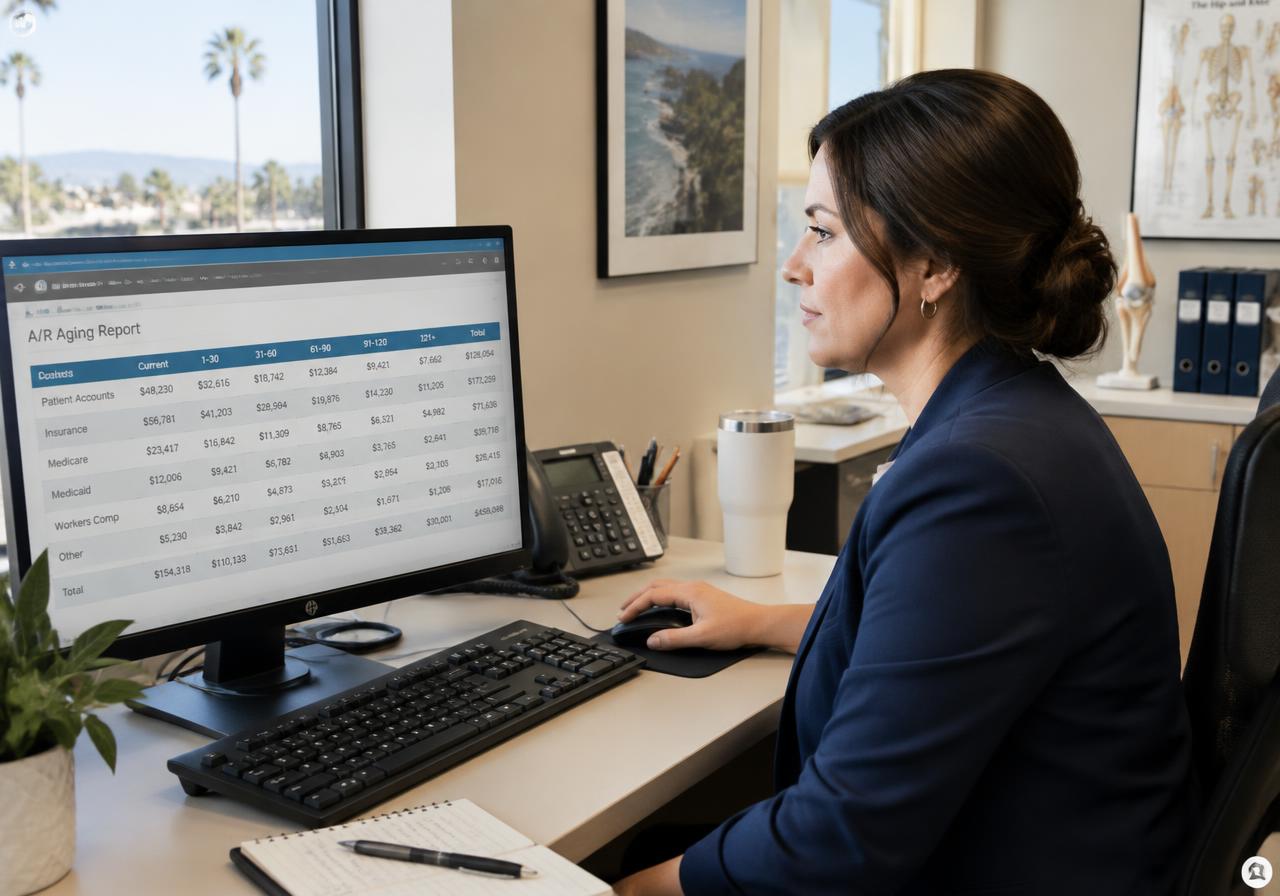
Give us read-only access to your aging report and we will come back with a written audit: your denial rate by payer and by surgeon, the claims still inside an appeal window, the workers' compensation Explanations of Review that were underpaid, and a number for what is recoverable. If the finding is that your current biller is doing a good job, we will say so, in writing.