
Personal Injury Billing Services for California Practices
Treat accident patients without carrying their bills for years. California Billing Services sets up every LOP and lien correctly, bills Med-Pay and health plans where they pay first, keeps attorneys updated on every case, and negotiates settlement payoffs, so your practice collects what it earned.
A PI billing specialist reviews your open cases. HIPAA- and CMIA-compliant; BAA signed before we see any records.
- Every case set up with a signed LOP or lien before billing
- Attorney status checks on a fixed schedule, logged per case
- Med-Pay, health plan, Medicare and Medi-Cal rules applied before the first claim
- One team for PI, workers' comp and insurance billing
Why Personal Injury Revenue Goes Uncollected
PI cases rarely fail at the claim. They fail at setup, during the long wait, or at the settlement table. These are the gaps we close:
| Where revenue leaks | What happens | How we prevent it |
|---|---|---|
| No signed LOP or lien | The attorney has no obligation to pay you from the settlement | Signed LOP or lien, plus the attorney's acknowledgment, before treatment is billed to the case |
| Wrong payer path chosen | Med-Pay or health coverage goes unused, or a Medi-Cal patient is billed on a lien | Coverage and payer path decided at intake |
| Attorney substitution | A new firm takes the case and doesn't know about your lien | Regular status checks; lien notice re-sent to any substituted attorney |
| Case settles without you | Funds are disbursed before your balance is paid | Lien on file, plus a written request for notice before disbursement |
| Records sent late or incomplete | The demand undervalues treatment, and the settlement shrinks | Complete records and itemized bills delivered promptly after each request |
| Reduction accepted without review | You take less than the case could support | Reduction requests reviewed against case value, fees and costs; your approval required |
| Balance written off after a loss | Patient liability under the LOP is never pursued | Patient balance billed per the LOP terms when a case is lost or dropped |
| Statute of limitations missed | No case, no recovery | Date-of-injury tracking with a 2-year alert, and 6 months for government defendants |

Built around accident-patient care
Every PI Case Starts at the First Visit
Accident details, insurers, attorney and coverage captured at intake decide who pays first and protect your balance.
Our Personal Injury Billing Services
California Billing Services manages the whole PI billing cycle, from the first visit to the final settlement check.
| Service | What we do |
|---|---|
| Case intake and verification | Capture the date and type of accident, the at-fault and patient insurers, claim numbers, the attorney, Med-Pay, health coverage, and Medicare or Medi-Cal status |
| LOP and lien setup | Send your LOP or lien agreement for patient and attorney signature, confirm the attorney's acknowledgment, and file hospital liens where they apply |
| Payer path decision | Decide, case by case, whether to bill Med-Pay, the health plan, Medicare or Medi-Cal first, or hold the balance for settlement |
| Coding and charge capture | Code injury diagnoses with the correct 7th character and external cause codes, complete the CMS-1500 accident fields, and code services to documentation |
| Med-Pay and insurance billing | Bill Med-Pay and health plans, follow up on payment, and track any reimbursement lien the payer asserts |
| Records and billing packages | Send itemized statements, medical records and narrative reports to attorneys and adjusters, and handle subpoenas with custodian declarations |
| Case status tracking | Check case status with each attorney on a set schedule: demand sent, in litigation, mediation, settled, or lost |
| Settlement and reduction negotiation | Review reduction requests against the settlement, fees and costs, recommend a payoff, and get your approval before accepting |
| Payment posting and close-out | Post settlement payments, record approved reductions as adjustments, and bill patient balances per the LOP when a case is lost |
| PI A/R reporting | Monthly report of open cases by age, stage and attorney, expected recovery, and settled-vs-billed ratios |
How much is sitting in your open PI cases?
Who Pays in a California Personal Injury Case
A PI case can have five or more possible payers. Choosing the wrong one first can cost you the balance, so we decide the payer path at intake.
| Payer path | When it applies | What to know |
|---|---|---|
| Letter of protection (LOP) | Patient has an attorney and you agree to wait for the settlement | Payment comes from the settlement, usually after a negotiated reduction; the patient generally stays responsible if the case is lost |
| Medical lien | Patient has an attorney and signs a lien on the recovery | In California, physician liens are contractual; only hospitals have a statutory lien under the Hospital Lien Act |
| Med-Pay | Patient's auto policy includes medical payments coverage | Pays regardless of fault, usually up to $1,000–$10,000; bill early, because other providers draw on the same limit |
| Health insurance | Patient has commercial coverage and you're in network | You accept the contracted rate; the plan may claim reimbursement from the settlement (limited by Civil Code §3040 for most non-ERISA plans) |
| Medicare | Patient is a Medicare beneficiary | You may pursue the liability insurer for 120 days (the promptly period). After that, billing Medicare means withdrawing your lien, except for non-covered amounts |
| Medi-Cal | Patient is a Medi-Cal member | Once you bill Medi-Cal, its payment is payment in full. DHCS recovers from the settlement; you don't |
| UM/UIM | At-fault driver is uninsured or underinsured | Recovery comes through the patient's own policy, often by arbitration; treat it like a liability case |
Our rule: We never treat a case as "lien only" before checking Med-Pay and health coverage, because using them first is often worth more than waiting.
California Rules That Decide What a PI Bill Is Worth
In California, what a provider collects on a PI case depends on the patient's insurance status, how the bill was handled, and which liens compete for the same settlement. We build every case around these rules.
Howell and Pebley: billed vs. paid amounts
Under Howell v. Hamilton Meats (2011), an insured plaintiff can recover only the amounts actually paid for care, not full billed charges. Pebley v. Santa Clara Organics (2018) allows a plaintiff who chooses to treat on a lien, even if insured, to present billed charges as evidence of reasonable value. Choosing between billing the health plan and treating on a lien changes what the case is worth, so we decide it before the first claim.
Competing liens on the same settlement
- Hospital liens: Hospitals have a statutory lien under Civil Code §§3045.1–3045.6, limited to a share of the patient's recovery.
- Health plan liens: Civil Code §3040 limits most non-ERISA health plan reimbursement claims to the amount paid and to one-third of the recovery when the patient has an attorney. Self-funded ERISA plans aren't bound by this cap.
- Medi-Cal and Medicare: DHCS and Medicare recover from the settlement, which reduces what's left for other lienholders.
- Attorney's fees: Contingency fees (commonly 33–40%) and case costs come off the top, which is why reduction requests follow.
Deadlines that end recovery
Most California personal injury claims must be filed within 2 years (CCP §335.1). Claims against a public entity, such as a city bus or a road defect, require a government claim within 6 months (Gov. Code §911.2). We track both from the date of injury and alert the attorney and your practice as they approach.
Privacy and compliance
We release records to attorneys only with a valid HIPAA authorization that also meets California's Confidentiality of Medical Information Act (CMIA). We answer subpoenas with a custodian of records declaration (Evidence Code §1561). We never pay or accept anything for patient or attorney referrals (Business & Professions Code §650), which protects your practice from fraud scrutiny.
Documentation That Gets PI Bills Paid in Full
Adjusters and defense attorneys look for reasons to discount treatment. Complete, consistent documentation supports the full value of your care during the demand, mediation and trial stages.
| Document | What it must show | Why it matters |
|---|---|---|
| Initial evaluation | Mechanism of injury, date, symptoms, prior history, objective findings | Establishes causation from the first visit |
| Progress notes | Functional change, response to treatment, plan | Supports medical necessity for continued care |
| ICD-10-CM coding | Injury codes with the correct 7th character (A, D, S), plus external cause codes (V00–Y99) | Links each service to the accident and shows the encounter stage |
| Itemized statement | Dates of service, CPT/HCPCS codes, units and charges, with payments and adjustments | The attorney's and adjuster's main valuation document |
| Narrative report | Diagnosis, causation opinion, prognosis, future care and its estimated cost | Often decides the value of future medical damages |
| Discharge or MMI note | Treatment end date and residual impairment | Closes the case for settlement |
| Custodian of records declaration | Authenticity of records and bills (Evidence Code §1561) | Required for subpoenaed records in litigation |
We audit each case file before the demand goes out and tell the provider what's missing while it can still be added.
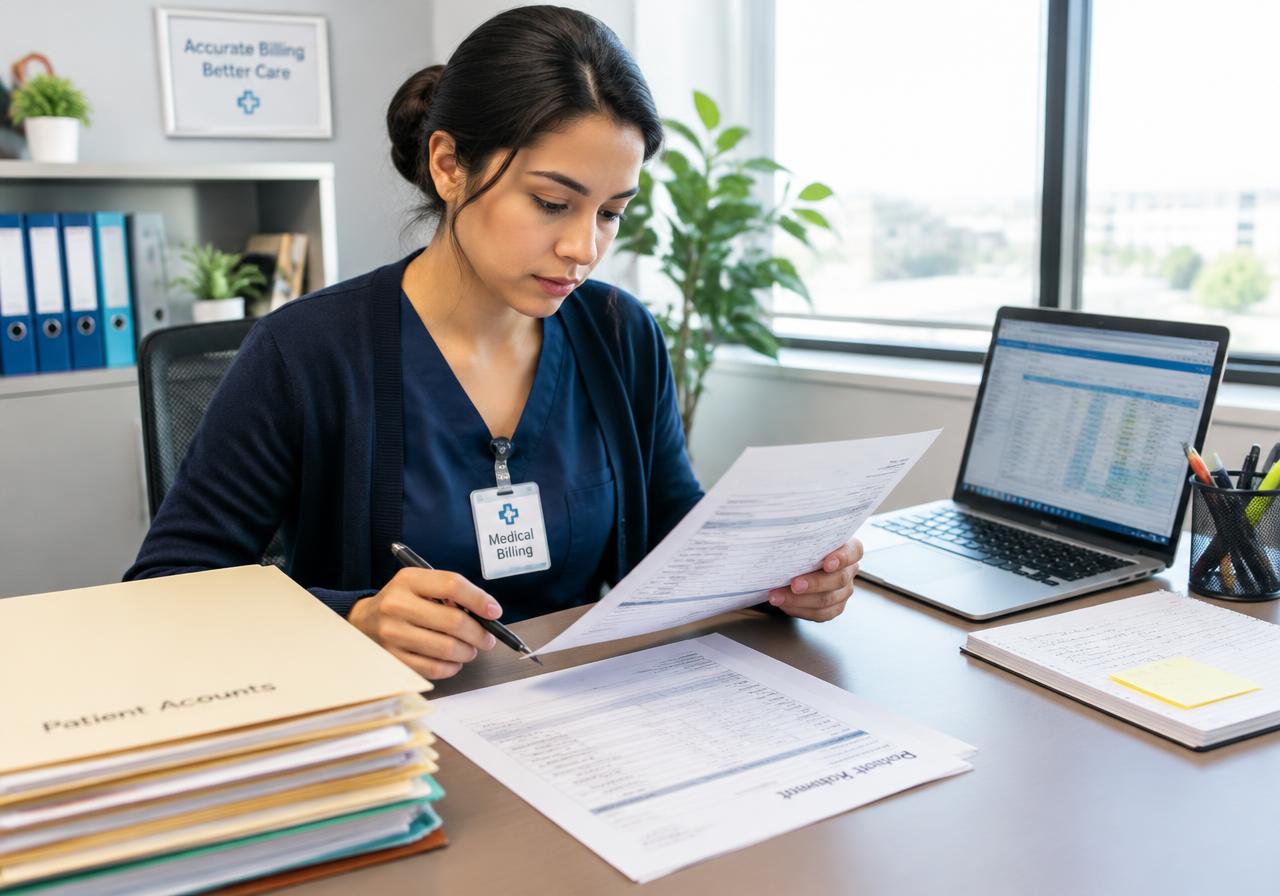
Records that hold their value
Every Case File Audited Before the Demand
Itemized statements, narratives and records are checked for gaps while they can still be fixed.
From First Visit to Settlement Check
- Intake. We capture accident, insurance and attorney details and confirm Medicare or Medi-Cal status.
- Payer path. We bill Med-Pay or the health plan, hold the balance on an LOP or lien, or combine the two.
- Agreement. We get the LOP or lien signed by the patient and acknowledged by the attorney.
- Billing. We code and bill each visit, and send itemized statements to the attorney monthly or on request.
- Case tracking. We check status with the attorney on a regular schedule and log every update: demand, litigation, mediation, trial date.
- Settlement. We review the attorney's reduction request against the gross settlement, fees, costs and other liens, then recommend a payoff for your approval.
- Collection and close-out. We post payment, record the approved reduction, and bill any patient balance owed under the LOP.
How we handle reduction requests
Every request gets a written review covering the gross settlement, attorney's fees and costs, competing liens, your share of total medical specials, and how strong your documentation is. We counter with a supported number, not a flat percentage, and we never accept a reduction without your sign-off.
Reporting PI receivables accurately
PI balances can sit open for 12 to 36 months. We report them by case stage and expected recovery, separately from insurance A/R, so your financial statements and cash forecasts reflect what you'll actually collect. That includes the implicit price concession that ASC 606 requires you to estimate.
Personal Injury Billing by Specialty
| Specialty | What we focus on in PI cases |
|---|---|
| Chiropractic | Visit frequency matched to documented progress, CMT codes 98940–98942 with the correct spinal regions, re-exam notes |
| Physical therapy | Timed-code units, functional outcome measures, a plan of care that justifies the visit count |
| Orthopedics and spine | Surgical estimates for demands, future care costs, implant and ASC charges on the lien |
| Pain management | Injection and procedure documentation (for example, epidurals and facet procedures) linked to imaging findings |
| Imaging | MRI and X-ray billing on lien, professional and technical components, report delivery to attorneys |
| Neurology | EMG/NCS testing, concussion and post-traumatic headache documentation |
| Ambulatory surgery centers | Facility charges on UB-04, separate lien agreements for facility and surgeon |
| Urgent care and primary care | First-visit documentation that establishes causation and referral need |
Treating injured workers too? See our workers' compensation billing services. Work injuries follow California's workers' comp system, not the PI process, even when a third party caused the accident.
PIP and No-Fault Billing Outside California
California uses a fault-based system, so California auto injuries are paid through Med-Pay, health coverage or the liability settlement. If your practice also treats patients in no-fault states, Personal Injury Protection (PIP) is billed first, under each state's own rules:
| State | Basic PIP | Rules that drive billing |
|---|---|---|
| Florida | $10,000 | Treatment must start within 14 days of the accident; payment tied to a Medicare-based fee schedule |
| New York | $50,000 | NF-3 claim form within 45 days of service; no-fault fee schedule; EUO and IME requests pause payment |
| New Jersey | $250,000 standard (lower options available) | Pre-certification rules; disputes go through PIP arbitration |
| Michigan | Coverage level chosen by the policyholder | Fee schedule tied to Medicare since the 2019 reform |
We bill PIP on deadline, respond to EUO and IME requests, track remaining benefits, and move the balance to health coverage or the liability claim when PIP is exhausted.
Why California Practices Choose California Billing Services for PI
| In-house front desk | Lien funding company | California Billing Services | |
|---|---|---|---|
| Who owns the receivable | You | The funder (bought at a discount) | You |
| What you collect | Whatever staff have time to chase | The purchase price, paid early | The full negotiated settlement, minus our fee |
| Attorney follow-up | Irregular | Funder's interest, not yours | Scheduled and logged for every case |
| Med-Pay, health plan, Medicare and Medi-Cal | Often missed | Usually out of scope | Applied case by case |
| Your other payers | Separate process | Not covered | One team for PI, workers' comp, commercial, Medicare and Medi-Cal |
What you get:
- California PI specialists. We're based in San Diego and know Howell, Pebley, Civil Code §3040 and the Hospital Lien Act.
- You stay in control. No reduction is accepted without your approval.
- Clean compliance. HIPAA- and CMIA-compliant record release, with no referral arrangements.
- Full visibility. Monthly reports by case stage, attorney and expected recovery.
Personal Injury Billing Pricing
| Option | Best for | How it's priced |
|---|---|---|
| Full PI billing and case management | Practices that treat accident patients every week | Percentage of PI collections, based on volume and specialty |
| Open-case portfolio recovery | A backlog of settled, stalled or forgotten cases | Contingency on amounts recovered |
| Combined PI and insurance billing | Practices that want one billing partner | Blended rate across payers |
You get a written quote after your case portfolio review.
Personal Injury Billing FAQs
They cover case intake, LOP and lien setup, choosing the payer path, coding and billing, records delivery to attorneys, case tracking, settlement and reduction negotiation, and payment posting. California Billing Services handles all of it, or only the parts you need.
Can't find what you're looking for? Contact our billing specialists
Your Open PI Cases Are Worth More When Someone Is Watching Them
Send us a list of your open personal injury cases. We'll show you which ones have a signed LOP, which attorneys haven't responded, which cases may have settled without you, and what the portfolio is realistically worth.
California Billing Services, 600 W Broadway, Suite 700, San Diego, CA 92101
California Billing Services provides billing and collection services for healthcare providers. This page describes billing processes and is not legal advice. Consult an attorney about lien agreements and case-specific questions.