


Published: November 12, 2026 · Muhammad Azam · 10 min read
Last updated: November 12, 2026
Quick Answer
Late-payment interest on California claims is money a payer owes your practice when it pays a complete claim after the legal deadline. For claims received on or after January 1, 2026, California health plans, insurers, Medi-Cal managed care plans and the IPAs that pay on their behalf owe 15% simple annual interest starting on day 31 after receipt. If they leave that interest off the payment, they owe an extra $15 or 10% of the interest, whichever is greater. Medicare and workers' compensation use their own rates and clocks. Source
Payers are supposed to add this interest automatically. Many don't. This guide shows your billing team how to calculate what each payer type owes, check remittances for it, and recover what's missing. It builds on our AB 3275 prompt pay law guide, which explains the 30-day rule itself, and is part of our California medical billing laws guide.
Key Takeaways
- Calculate simple interest on the amount paid late, not billed charges.
- Use the correct payer rate and receipt-based payment clock.
- Check the remittance for interest and any omitted-interest penalty.
- Keep receipt evidence and calculations with each payment dispute.
Late claim interest at a glance
Late claim interest rates, start dates and penalties depend on the payer type.
| Payer type | Interest rate | Starts | Penalty if interest is left off |
|---|---|---|---|
| HMOs, plan PPOs, Medi-Cal managed care plans, IPAs | 15% per year | Day 31 after receipt | Greater of $15 or 10% of interest Source |
| Insurer-issued PPO and indemnity policies | 15% per year | Day 31 after receipt | Greater of $15 or 10% of interest Source |
| Original Medicare (Noridian JE) | 4.750% (Jul-Dec 2026) | Day 31 after receipt | None; added on the remittance Source |
| Workers' compensation | 15% penalty plus 10% per year interest | After day 45 (60 for government employers) | Recover by second bill review, then lien Source |
| Medi-Cal fee-for-service, self-funded employer plans | No California prompt-pay interest | , | , Source |
The Formula for Late Claim Interest
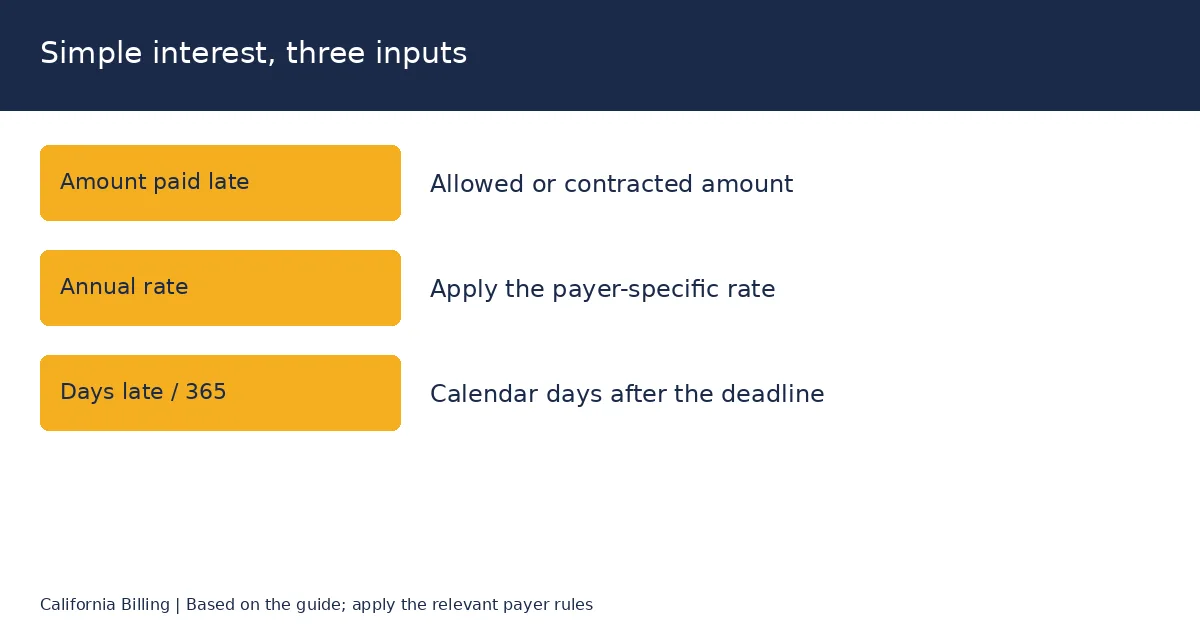
California late claim interest is simple interest: the unpaid amount, times the annual rate, times the fraction of a year the payment was late.
Interest = amount paid late × annual rate × days late ÷ 365
Each term, from your practice's side:
- Amount paid late is what the payer owed and paid after the deadline. Use the allowed or contracted amount the payer paid, not your billed charges.
- Annual rate depends on the payer type (next section).
- Days late count from the first day after the deadline to the day payment reaches you. For a 30-day rule, a claim paid on day 50 is 20 days late. Source
The statutes don't provide for compounding, so don't add interest on interest. Divide by 365, not 360. Source
Interest Rates by California Payer Type
The rate depends on who pays the claim, so identify the payer type before you calculate. The patient's ID card, the plan's evidence of coverage or the payer's response usually tells you whether a plan is DMHC-regulated, CDI-regulated, Medicare or self-funded.
| Payer type | Legal source | Pay deadline | Interest rate | Penalty if interest is omitted |
|---|---|---|---|---|
| DMHC plans: HMOs, POS plans, plan-issued PPOs, Medi-Cal managed care plans and their delegated IPAs and medical groups | Health & Safety Code §1371 and §1371.35 | 30 calendar days | 15% per year, emergency claims included | Greater of $15 or 10% of accrued interest Source |
| CDI insurers: insurer-issued PPO and indemnity policies | Insurance Code §10123.13 and §10123.147 | 30 calendar days | 15% per year | Greater of $15 or 10% of accrued interest Source |
| Original Medicare | CMS Claims Processing Manual, ch. 1 §80.2.2 | 30 days after receipt | Treasury prompt payment rate: 4.750% Jul-Dec 2026; 4.125% Jan-Jun 2026 | None Source |
| Workers' compensation | Labor Code §4603.2 | 45 days (60 for government employers) | 15% penalty plus 10% per year interest | , Source |
Two changes from 2026 matter most for California practices:
- Insurers now pay 15%, not 10%. Before 2026, CDI-regulated insurers paid 10% per year. The current statute sets 15% for claims received on or after January 1, 2026, matching health plans (CMA summary). Source
- The penalty is larger and covers more claims. The old $10 fee is now the greater of $15 or 10% of the interest, and the DMHC's AB 3275 guidance confirms it applies to all claims, including emergency services. Source
For which plans the 30-day rule covers and which it doesn't, see who AB 3275 applies to.
When the 30-Day Clock Starts and Stops
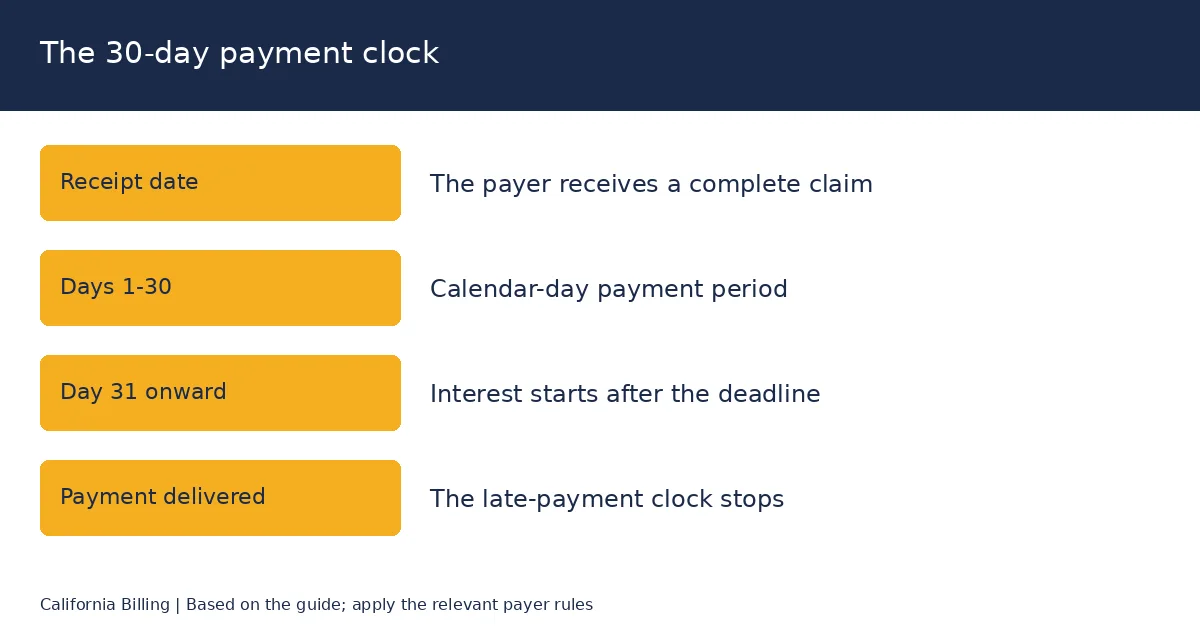
The clock starts on the date the payer receives a complete claim and stops on the date payment is delivered to you. Getting either date wrong changes every calculation that follows.
- Use the receipt date, not the date of service or the date you sent it. It appears on the 277CA claim acknowledgment from your clearinghouse or in the payer's portal. Save it with every claim; it's your proof if the payer disputes the timeline.
- Count calendar days. For claims received on or after January 1, 2026, weekends and holidays count. Day 31 is the first day of interest. Source
- Contested claims get a new clock. If the payer sends written notice within 30 days that it needs more information, interest on that claim starts 30 days after the payer receives what it asked for. Source
- Claims received in 2025 follow the old rules. Those used 30 working days (45 for HMOs), 10% interest for insurers and a $10 fee. A December 2025 visit billed in January 2026 falls under the new rules because the receipt date decides. Source
- Claims sent to the wrong payer may not start the clock. If you bill the health plan when the IPA owes the claim under the Division of Financial Responsibility (DOFR), the clock may not run until the right payer receives it. Confirming the payer during eligibility verification prevents this.
Worked Examples
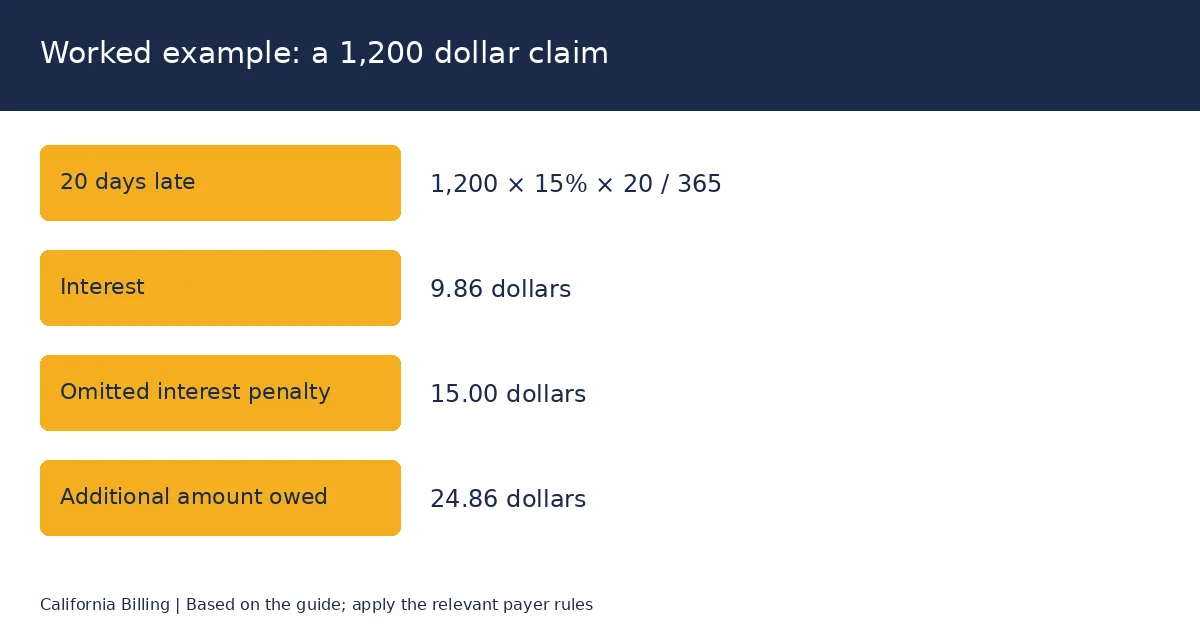
These four examples cover the late payments California practices see most often. Each shows the full calculation so your team can repeat it.
| Example | Facts | Days late | Interest | Penalty if omitted | Total owed |
|---|---|---|---|---|---|
| A. HMO or Medi-Cal managed care plan | $1,200 complete claim received Mar 2, 2026; paid Apr 21, 2026 (day 50) | 20 | $1,200 × 15% × 20 ÷ 365 = $9.86 | Greater of $15 or $0.99 = $15.00 | $24.86 Source |
| B. Contested claim line | $600 line contested; plan received your records May 4, 2026; paid Jun 20, 2026 (day 47 after records) | 17 | $600 × 15% × 17 ÷ 365 = $4.19 | $15.00 | $19.19 Source |
| C. Original Medicare | $800 clean claim received Aug 3, 2026; paid Sep 14, 2026 (day 42) | 12 | $800 × 4.75% × 12 ÷ 365 = $1.25 | None | $1.25 Source |
| D. Workers' compensation | $500 OMFS-allowed bill received Jan 5, 2026; paid Apr 20, 2026 (105 days after receipt) | Past day 45 | 15% penalty: $75.00, plus $500 × 10% × 105 ÷ 365 = $14.38 | , | $89.38 Source |
What the examples show
- The penalty usually outweighs the interest. On a typical claim, 10% of the interest is under $15, so the $15 minimum applies. That makes missing interest worth chasing even on small claims.
- Contested lines need their own clock. In Example B, the 30 days run from when the plan received your records, not from the original claim.
- Medicare interest is small but automatic. It should appear on the remittance without any request.
- Workers' comp counts interest from receipt of the bill. Once a bill is paid after the 45-day window, the 10% interest runs from the date the claims administrator received it, and the 15% penalty is calculated on the fee-schedule amount (DaisyBill).
Why it adds up
As an illustration: a practice with 200 commercial claims a month paid after day 30, none with interest, is owed at least $3,000 a month in penalties alone (200 × $15), before any interest.
Check what your payers owe in late-payment interest.
Book a 20-minute revenue reviewSpecial Cases Billing Teams Miss
Interest is owed on more claims than most practices track. Check these five situations before writing off a late payment as "paid in full."
- IPAs and medical groups. When an IPA pays a claim under the plan's DOFR, it owes the same 15% interest and penalty. The DMHC requires plans to make sure their delegated entities comply. Source
- Emergency claims. Since 2026, emergency claims carry both the interest and the penalty for DMHC plans. Source
- Partial payments. If the payer pays some lines on time and contests others, interest runs only on the lines paid late.
- Underpayments corrected later. When a payer fixes an underpayment after day 30, the corrected amount was paid late. Ask for interest on the difference, citing the original receipt date; payers that didn't contest the claim in writing have little ground to start the clock later. Source
- Repeated misses. A payer that keeps paying late or leaving out interest may be showing an unfair payment pattern under California claims rules, which can strengthen a dispute (Davis Wright Tremaine). Track missed interest by payer, not just by claim.
You can never bill the patient for interest or penalties. They're owed by the payer only.
Payers With Different Rules
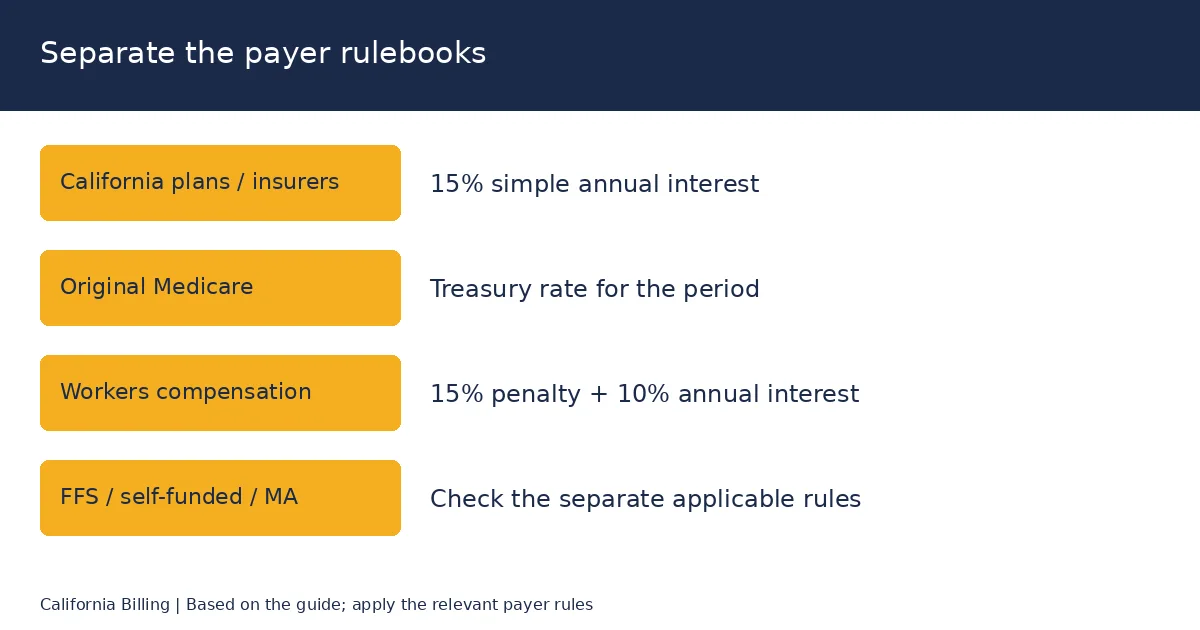
Medicare, workers' comp, Medi-Cal fee-for-service, self-funded plans and Medicare Advantage don't follow California's 15% rule. Tag these payers separately in your A/R system so your team applies the right math.
Original Medicare
Noridian, the Medicare contractor for California, must pay interest on clean claims not paid within 30 days of receipt. The rate is the Treasury prompt payment rate, reset every January 1 and July 1: 4.750% for July-December 2026 (Noridian JE Part B). Interest isn't paid on full denials, claims with no payment due, or claims needing outside investigation. Medicare adds interest to the remittance itself, so you're checking for it, not requesting it. Current and past rates are on the Treasury prompt payment page. Source
Workers' compensation
Under Labor Code §4603.2, a claims administrator that pays a properly documented bill after 45 days (60 days for government employers) owes a 15% penalty plus 10% per year interest. E-bills are due within 15 working days, but penalty and interest still start only after the 45- or 60-day window. You can't bill penalty and interest as a line item. If they're missing, request a second bill review, then file a lien if needed. See how we handle workers' comp billing. Source
Medi-Cal fee-for-service
AB 3275 doesn't cover claims billed directly to DHCS. The bigger risk runs the other way: late claims you submit lose 25% to 50% of their value after six months from the month of service. See our Medi-Cal billing guide.
Self-funded employer plans
Many large California employers self-fund their plans even when a familiar insurer administers them. California's interest rules don't reach these ERISA plans; the plan's own terms apply.
Medicare Advantage
Medicare Advantage plans follow federal rules and your contract, not AB 3275. Check your contract's prompt payment and interest terms before calculating.
How to Check Remittances for Missing Interest
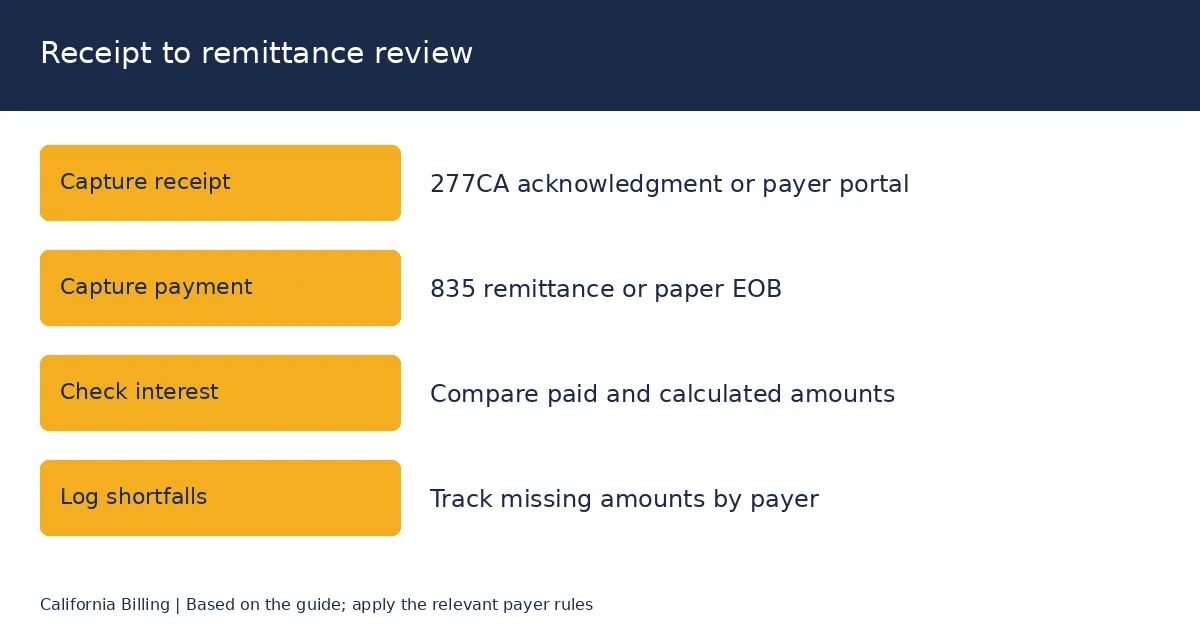
Compare the payer's receipt date with the payment date on every claim paid after day 30. A weekly check takes your team a few minutes per payer once it's set up.
- Pull the receipt date from the 277CA acknowledgment or the payer portal.
- Pull the payment date from the 835 electronic remittance (ERA) or the paper EOB.
- Flag every claim paid more than 30 days after receipt (45 or 60 for workers' comp).
- Look for an interest line. On an 835, interest often appears as a provider-level adjustment rather than on the claim line; ask your clearinghouse how it displays.
- Calculate what was owed with the formula above, using the right rate for the payer type.
- Log the shortfall by payer: interest owed, interest paid, penalty owed.
Aging A/R by date of service hides this problem. Add a "days since receipt" view for commercial and Medi-Cal managed care payers so late payments surface on day 31.
What to Do When Interest Is Missing
Ask for it first, dispute it second, and escalate to the regulator only if the payer ignores the process.
- Request payment. Contact the plan or IPA, cite the receipt date and your calculation, and ask for the interest plus the penalty. Note the call reference number.
- File a provider dispute. If it isn't paid, file through the payer's provider dispute resolution process within 365 days of the payment. California provider dispute guide
- Escalate. For DMHC-regulated plans and their IPAs, file a provider complaint with the Department of Managed Health Care. For insurer-issued policies, contact the California Department of Insurance. DMHC and CDI complaint paths
- Workers' comp: request a second bill review, then file a lien if the administrator still doesn't pay.
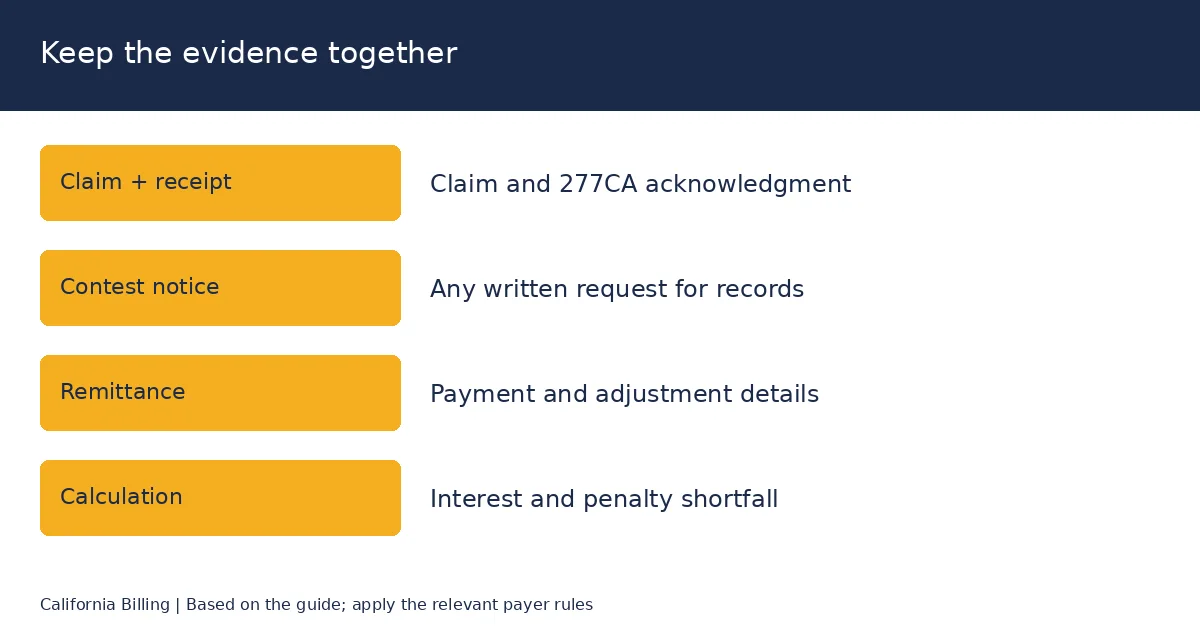
Keep an evidence file for each disputed claim: the claim, the 277CA, any contest notice, the remittance and your interest calculation. Our denial management team can review the same evidence for payment disputes.
How California Billing Recovers Late-Payment Interest
Our A/R follow-up and late-payment interest recovery team can discuss the review workflow with California practices:
- Tag every payer by type, so each claim gets the right rate and clock.
- Review late payments received since January 1, 2026 and calculate the interest and penalty owed.
- Request and dispute the shortfall with the plan, IPA or claims administrator, and escalate when payers don't respond.
- Report recovered interest by payer, so you can see which plans pay late.
Request a revenue review and we'll show you what your payers owe.
Sources
Use the current statute and payer guidance for the claim you are reviewing.
Frequently Asked Questions
For complete claims received on or after January 1, 2026, DMHC-regulated health plans, CDI-regulated insurers, Medi-Cal managed care plans and their delegated IPAs owe 15% simple annual interest starting the first calendar day after the 30-day payment period. If they don't include it automatically, they owe the greater of $15 or 10% of the interest.
Can't find what you're looking for? Contact our billing specialists