


November 16, 2026 · Muhammad Azam · 9 min read

Clean claim rate is the percentage of medical claims a payer accepts on the first submission, with no corrections, rejections, or requests for more information. Most practices should hold a clean claim rate of 95% or higher, and high-performing billing teams reach 98% or more.
A clean claim rate shows how accurate your front desk, coding, and charge entry are before a payer ever reviews the service. This guide explains the formula, gives a worked example, sets benchmark ranges, and covers the California payment rules that reward clean submissions. If your rate sits below 95%, our medical billing services team can find the root causes.
What is a clean claim rate in healthcare revenue cycle management?
Clean claim rate (CCR) is a revenue cycle management KPI that measures the share of claims accepted on first submission without manual correction. It is reported as a percentage for a fixed period, usually one calendar month.
A high clean claim rate means fewer rejections, less rework, and faster payment. A low clean claim rate means staff spend time fixing errors that should have been caught before the claim left the practice.
Clean claim rate measures acceptance, not payment. A claim can be accepted as clean and still be denied later for medical necessity or coverage reasons. That second outcome is tracked by first pass yield and denial rate, covered below.
What is a clean claim?
A clean claim is a claim that a payer can process without obtaining additional information from the provider or a third party. This is the federal definition used for Medicaid in 42 CFR 447.45(b), and most commercial payer contracts use similar wording.
California uses the term "complete claim" in Title 28, California Code of Regulations, section 1300.71(a). In practice the meaning is the same: every required field is present, valid, and consistent with the payer's rules.
A clean claim contains these data elements:
- Patient and subscriber data: legal name, date of birth, sex, address, member ID, group number, and relationship to subscriber, exactly as the payer has them.
- Provider data: billing and rendering NPI, taxonomy code, tax ID, and service facility location.
- Coding data: ICD-10-CM diagnosis codes at full specificity, CPT or HCPCS Level II procedure codes, required modifiers, and correct diagnosis pointers.
- Service data: dates of service, place of service code, units, and charges.
- Authorization data: prior authorization or referral number when the service requires one.
- Format: a valid CMS-1500 or 837P for professional claims, or a UB-04 or 837I for institutional claims, filed within the payer's timely filing limit.
How do you calculate clean claim rate?
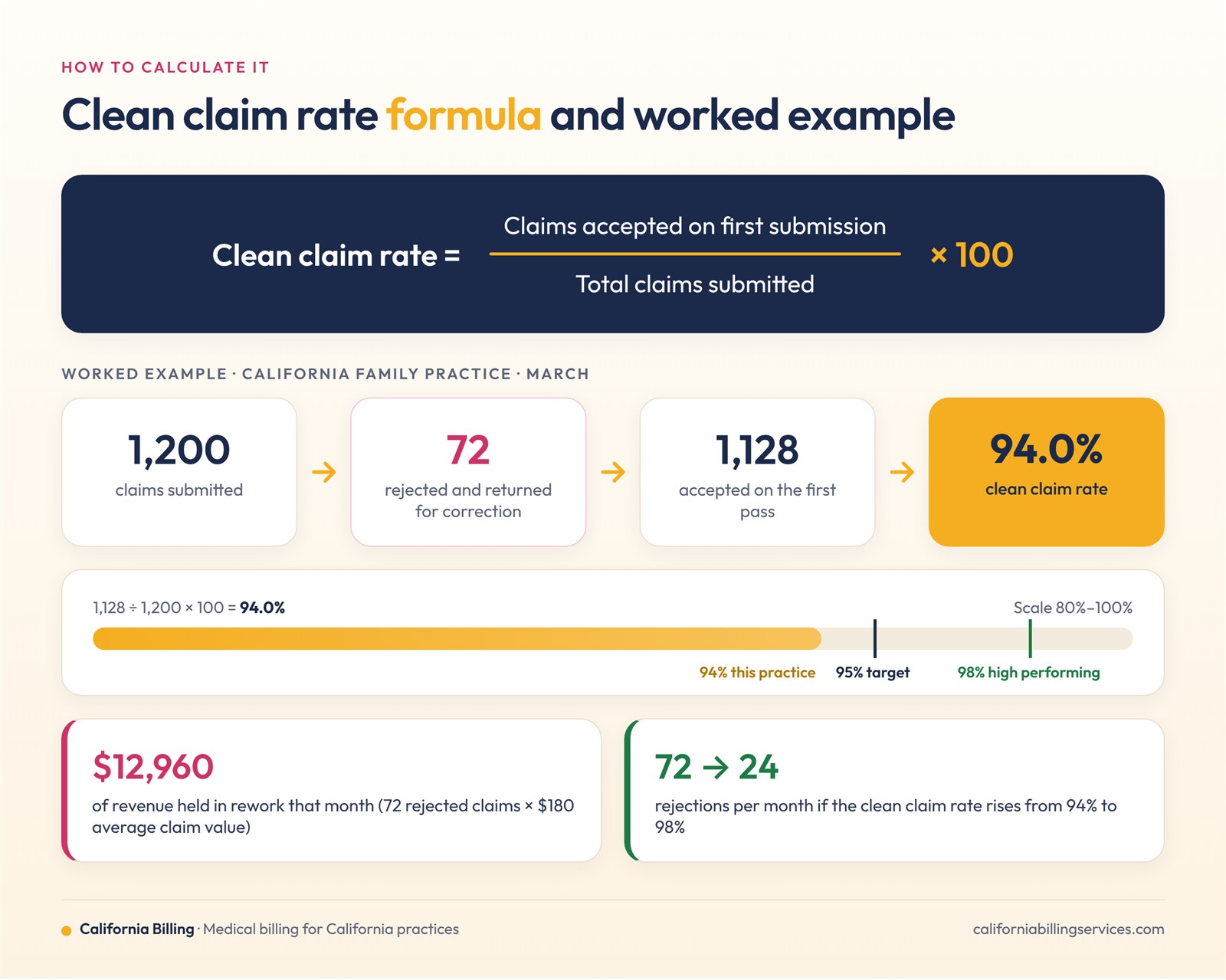
Clean claim rate equals the number of claims accepted on first submission divided by the total number of claims submitted in the same period, multiplied by 100.
Clean claim rate = (Claims accepted on first submission ÷ Total claims submitted) × 100
Worked example
A California family practice submits 1,200 claims in March. The payer acknowledgment reports show 72 claims rejected and returned for correction. That leaves 1,128 claims accepted on the first pass.
1,128 ÷ 1,200 × 100 = 94.0% clean claim rate.
At an average claim value of $180, those 72 rejected claims hold $12,960 of revenue in rework that month. Raising the rate to 98% would cut rejections to 24 claims.
What to count and what to exclude
- Count each claim once, in the month it was first submitted.
- Do not count corrected or replacement claims (frequency code 7) as new first submissions.
- Exclude voided claims, duplicate test files, and claims held internally that were never sent.
- Measure at the claim level, not by line item or by dollar amount, so results stay comparable across payers.
Where is clean claim rate measured?
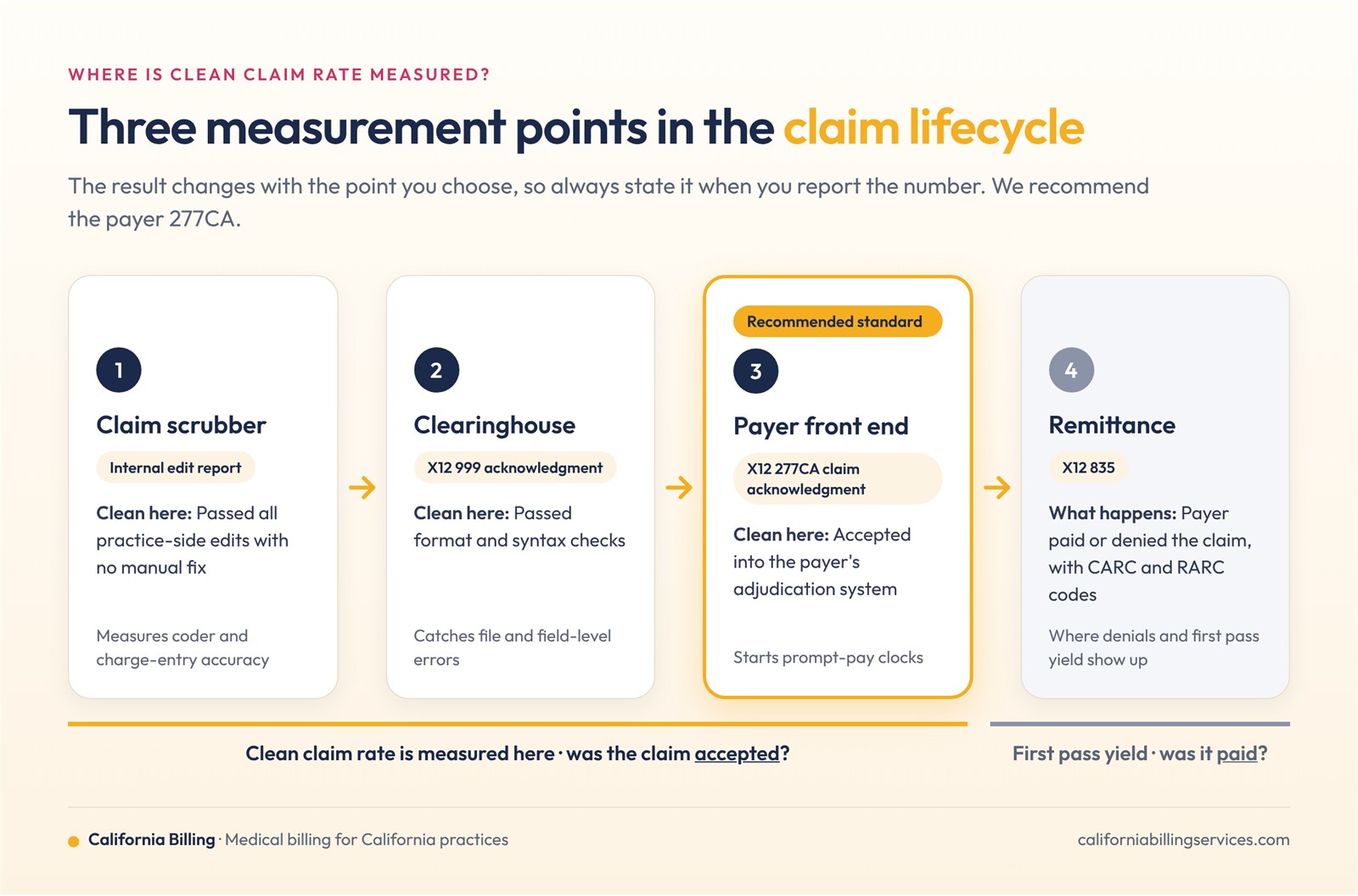
Clean claim rate can be measured at three points in the claim lifecycle, and the result changes depending on which point you choose. Always state the measurement point when you report the number.
| Measurement point | Electronic signal | What a "clean" claim means here | Typical use |
|---|---|---|---|
| Claim scrubber (pre-submission) | Internal edit report | Passed all practice-side edits with no manual fix | Measures coder and charge-entry accuracy |
| Clearinghouse | X12 999 acknowledgment | Passed format and syntax checks | Catches file and field-level errors |
| Payer front end | X12 277CA claim acknowledgment | Accepted into the payer's adjudication system | Recommended standard for reporting |
We recommend the payer 277CA as the standard measurement point. It reflects what the payer actually accepted, which is the event that starts prompt-pay clocks.
What is a good clean claim rate?
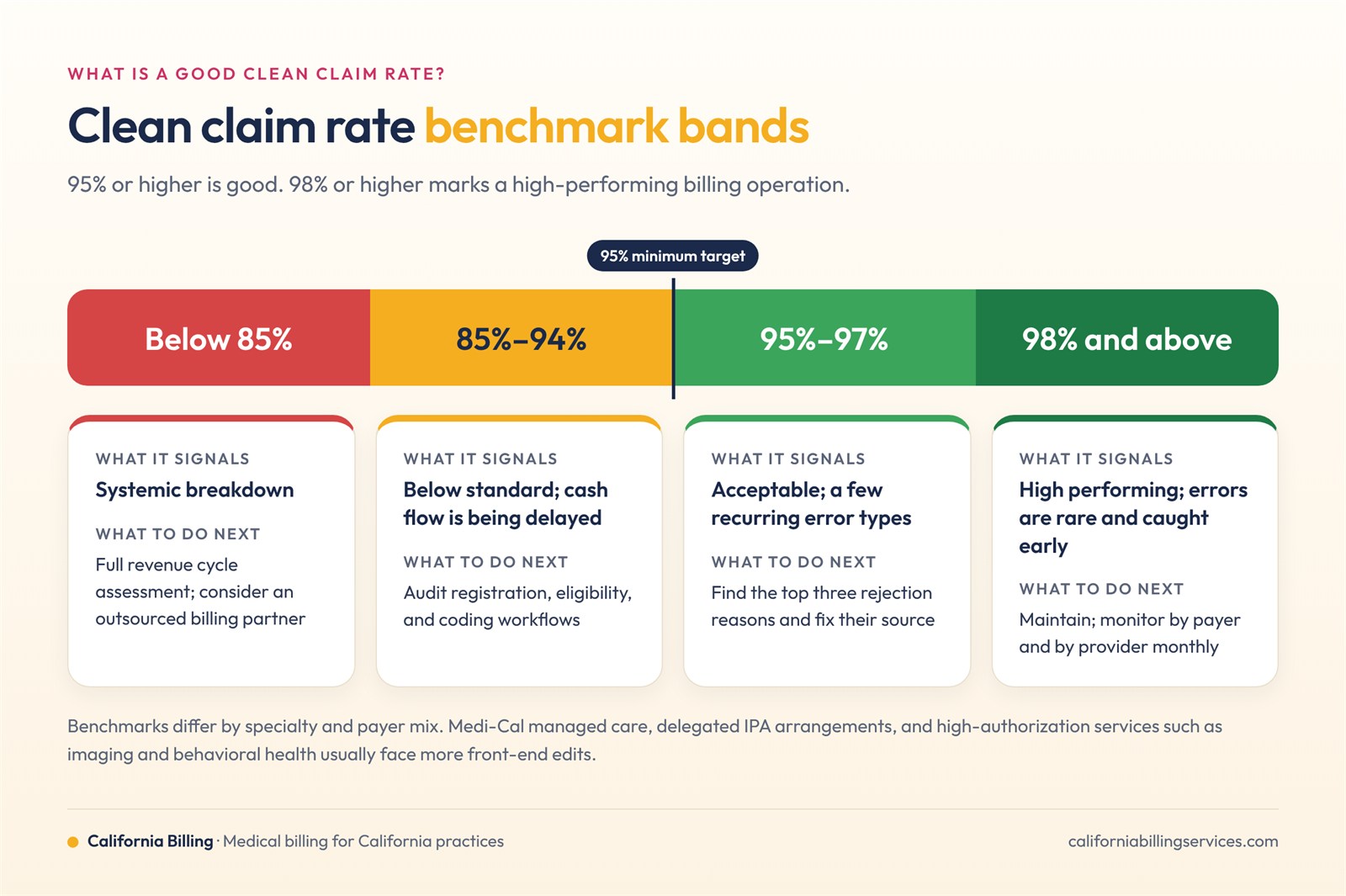
A good clean claim rate is 95% or higher, and 98% or higher is the mark of a high-performing billing operation. Published benchmarks vary: revenue cycle vendors cite targets from 90% to 95%, and top-tier targets of 98% are common in industry guidance.
| Clean claim rate | What it signals | What to do next |
|---|---|---|
| 98% and above | High performing; errors are rare and caught early | Maintain; monitor by payer and by provider monthly |
| 95%–97% | Acceptable; a few recurring error types | Find the top three rejection reasons and fix their source |
| 85%–94% | Below standard; cash flow is being delayed | Audit registration, eligibility, and coding workflows |
| Below 85% | Systemic breakdown | Full revenue cycle assessment; consider an outsourced billing partner |
Benchmarks also differ by specialty and payer mix. Practices with many Medi-Cal managed care patients, delegated IPA arrangements, or high-authorization services such as imaging and behavioral health usually face more front-end edits.
Clean claim rate vs. first pass yield vs. denial rate
Clean claim rate measures whether a claim was accepted; first pass yield measures whether it was paid; denial rate measures how many accepted claims the payer refused. Tracking all three shows where revenue is lost.
| KPI | What it measures | Formula | Common target |
|---|---|---|---|
| Clean claim rate | Claims accepted on first submission | Accepted first pass ÷ total submitted × 100 | 95%+ |
| First pass yield (first pass resolution rate) | Claims paid on first submission | Paid first pass ÷ total submitted × 100 | 90%+ |
| Denial rate | Adjudicated claims denied | Denied ÷ total adjudicated × 100 | Under 5% |
| Days in A/R | Average time to collect | Total A/R ÷ average daily charges | Under 40 days |
| Net collection rate | Share of allowed amount collected | Payments ÷ (charges − contractual adjustments) × 100 | 95%+ |
A high clean claim rate paired with a low first pass yield points to problems the payer finds during adjudication, such as medical necessity or coverage issues. A low clean claim rate points to errors your team can fix before submission.
Claim rejection vs. claim denial
A claim rejection happens before adjudication: the claim never enters the payer's system, so you correct it and resubmit. A claim denial happens after adjudication: the payer processed the claim and refused payment, reported with CARC and RARC codes on the 835 remittance. Rejections lower your clean claim rate; denials lower your first pass yield.

What causes a low clean claim rate?
Most rejections start at the front desk, not in coding. Registration and eligibility errors are the most common source, followed by coding edits and provider enrollment data.
| Revenue cycle stage | Common error | Example rejection reason |
|---|---|---|
| Scheduling and registration | Misspelled name, wrong date of birth, outdated member ID | Subscriber or patient not found |
| Eligibility verification | Coverage terminated or wrong payer on file | Coverage not in effect on date of service |
| Authorization and routing | Missing prior authorization; claim sent to the health plan instead of the delegated IPA | Authorization number missing or invalid |
| Coding | NCCI edit conflicts, MUE unit limits exceeded, missing modifier, unspecified ICD-10-CM code | Procedure-to-diagnosis or modifier edit failure |
| Charge entry | Wrong place of service, units, or date span | Invalid place of service for procedure |
| Provider data | Rendering NPI not enrolled with the payer; taxonomy mismatch | Rendering provider not eligible |
| Submission | Claim filed after the timely filing limit | Timely filing exceeded |
California practices face one extra routing risk. Under the delegated model, many HMO claims must go to the IPA or medical group named in the Division of Financial Responsibility (DOFR), not to the health plan. A claim sent to the wrong entity is returned and counts against your clean claim rate.
How to improve your clean claim rate
Improving your clean claim rate means moving error checks earlier in the workflow, before the claim is built. These eight steps address the causes above in order.
- Verify eligibility 48–72 hours before the visit. Run a 270/271 eligibility check at scheduling and again at check-in for high-value services.
- Capture identity data from the insurance card. Match name, date of birth, and member ID exactly; scan both sides of the card.
- Confirm authorization and payer routing. Record the authorization number and check the DOFR so the claim goes to the correct plan, IPA, or medical group.
- Scrub every claim before release. Use a claim scrubber that applies NCCI procedure-to-procedure edits, MUE limits, and payer-specific rules.
- Keep provider enrollment current. Maintain NPI, taxonomy, and payer enrollment records for every rendering provider, and track revalidation dates.
- Work 999 and 277CA reports the same day. Fix and resubmit rejections within 24 hours so they do not age.
- Categorize every rejection. Tag each one by root cause and stage, review the top three causes monthly, and retrain the team that produced them.
- Report clean claim rate by payer and by provider. A practice-wide average hides the single payer or clinician driving most rejections.
California rules that make clean claims pay faster
In California, a complete claim triggers strict payment deadlines, so a high clean claim rate converts directly into faster cash. From January 1, 2026, Assembly Bill 3275 requires health plans to pay a complete claim within 30 calendar days of receipt, replacing the older 30- and 45-working-day limits.
- Health care service plans (DMHC-regulated): Pay complete claims within 30 calendar days. Interest accrues at 15% per year from day 31, and a plan that fails to pay that interest owes the greater of $15 or 10% of the accrued interest (DMHC APL 25-007).
- Contested claims: The plan must contest or deny within the same 30 calendar days and name the contested portion by procedure or revenue code. It may not contest a claim that matches the services approved by prior authorization when the documentation is on the claim.
- Health insurers (CDI-regulated): AB 3275 also amended Insurance Code section 10123.13, applying the 30-calendar-day standard to health insurers.
- Medi-Cal managed care plans: Under the DHCS contract, plans must pay at least 90% of clean claims within 30 calendar days and 99% within 90 days.
- Medicare: Noridian, the Medicare Administrative Contractor for California (Jurisdiction E), pays clean electronic claims after a 14-day payment floor and within 30 days of receipt.
These protections apply only to claims that are complete. An incomplete claim gives the payer a lawful reason to contest it, and the clock restarts when you send the missing information.
Get your clean claim rate above 98%
California Billing Services audits your rejection reports, fixes the front-end workflows behind them, and reports clean claim rate by payer every month. Talk to our medical billing services team for a free clean claim assessment.
Sources
This article is general information, not legal advice. Confirm payment rules in your payer contracts and provider manuals.
Frequently asked questions about clean claim rate
Clean claim rate = (claims accepted on first submission ÷ total claims submitted) × 100. Use the same period, usually one month, for both numbers.
Can't find what you're looking for? Contact our billing specialists