


Published: November 13, 2026 · Muhammad Azam · 8 min read
Last updated: November 13, 2026
Quick Answer
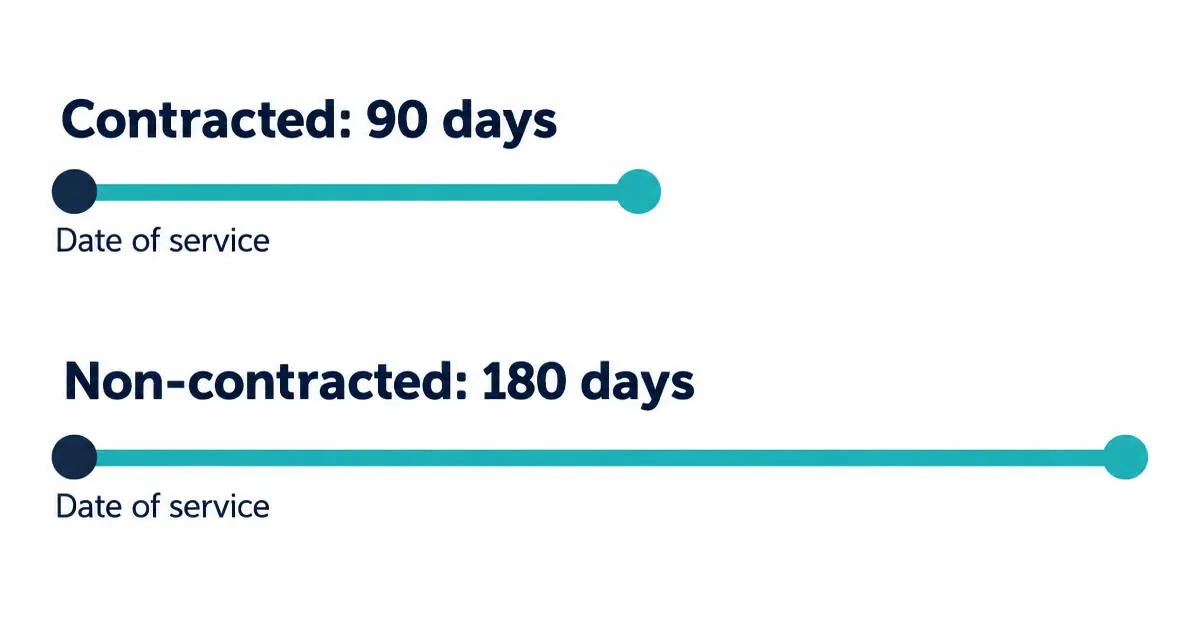
California timely filing limits for commercial plans under 28 CCR § 1300.71 give contracted providers at least 90 calendar days and non-contracted providers at least 180 calendar days from the date of service. Secondary claims typically get 90 days from the primary EOB, and disputes get 365 days from the payer action. Source
In California, missed filing deadlines are one of the fastest ways for a medical practice to lose collectible revenue, because once a claim passes its statutory or contractual window, payers can issue a non-appealable administrative write-off. These limits come from the Knox-Keene Health Care Service Plan Act and 28 CCR § 1300.71, and they interact with your provider contract. This guide covers deadlines for contracted and non-contracted providers, payment mandates, dispute windows and late-filing denials.
Key Takeaways
- Contracted commercial claims: at least 90 calendar days from date of service.
- Non-contracted commercial claims: at least 180 calendar days from date of service.
- When your contract allows longer than the regulation, the longer window applies.
- Good cause can overturn a late-filing denial through a PDR filed within 365 days.
What Is 28 CCR § 1300.71?
28 CCR § 1300.71, the Claims Settlement Practices regulation, sets the legal standards for how health plans regulated by the California Department of Managed Health Care (DMHC) must process, pay, contest or deny provider claims. Source
ERISA self-funded employer plans fall under federal jurisdiction. Fully insured commercial HMO and PPO plans regulated by the DMHC, including major California carriers like Blue Shield of California, Health Net, Kaiser Permanente and Anthem Blue Cross HMO products, must comply with 28 CCR § 1300.71.
Which plans follow which rules
- DMHC-regulated HMO and managed care plans: 28 CCR § 1300.71.
- ERISA self-funded employer plans: federal rules, not this regulation.
- Traditional indemnity and certain PPO plans regulated by the California Department of Insurance (CDI): parallel prompt-pay rules under California Insurance Code § 10123.13 and 10 CCR § 2695.11.
California Commercial Timely Filing Limits at a Glance
California timely filing limits for commercial plans are at least 90 calendar days for contracted providers and 180 calendar days for non-contracted providers, under 28 CCR § 1300.71(b).
| Provider network status | Minimum statutory filing limit | Key governing rule and notes |
|---|---|---|
| Contracted (in-network) | 90 calendar days from date of service (DOS) | Plans cannot set a deadline shorter than 90 days. Your contract may allow longer (for example, 120 or 180 days). |
| Non-contracted (out-of-network) | 180 calendar days from date of service (DOS) | State law guarantees at least 180 days for out-of-network commercial claims under DMHC plans. |
| Coordination of benefits (COB) | 90 days from primary EOB date | When billing a secondary payer, the clock typically starts from the date of the primary insurer's Explanation of Benefits. |
| Provider Dispute Resolution (PDR) | 365 calendar days from payer action | Minimum window to contest an underpayment, denial or recoupment request under 28 CCR § 1300.71.38. |
Contracted vs. Non-Contracted Deadlines Explained
Contracted providers get a minimum of 90 days to file a commercial claim in California, and non-contracted providers get a minimum of 180 days.
In-network providers (minimum 90 days)
A DMHC-regulated health plan cannot enforce a timely filing limit shorter than 90 calendar days from the date of service (or date of discharge for inpatient care). Always check your Participating Provider Agreement: many California commercial contracts extend this window to 120 or 180 days. Where the contract and regulation differ, the longer timeframe protects the provider.
Out-of-network providers (minimum 180 days)
If you do not have a written contract with the patient's health plan, 28 CCR § 1300.71(b)(2) prohibits the plan from imposing a timely filing deadline shorter than 180 calendar days from the date of service.
For a broader breakdown of California commercial, Medi-Cal and Medicare billing workflows, explore our complete California medical billing guide. For each payer's published limit, see our California timely filing limits by payer chart.
Worried claims are aging past their filing window?
Book a 20-minute revenue reviewPayer Payment Deadlines and Interest Penalties in California
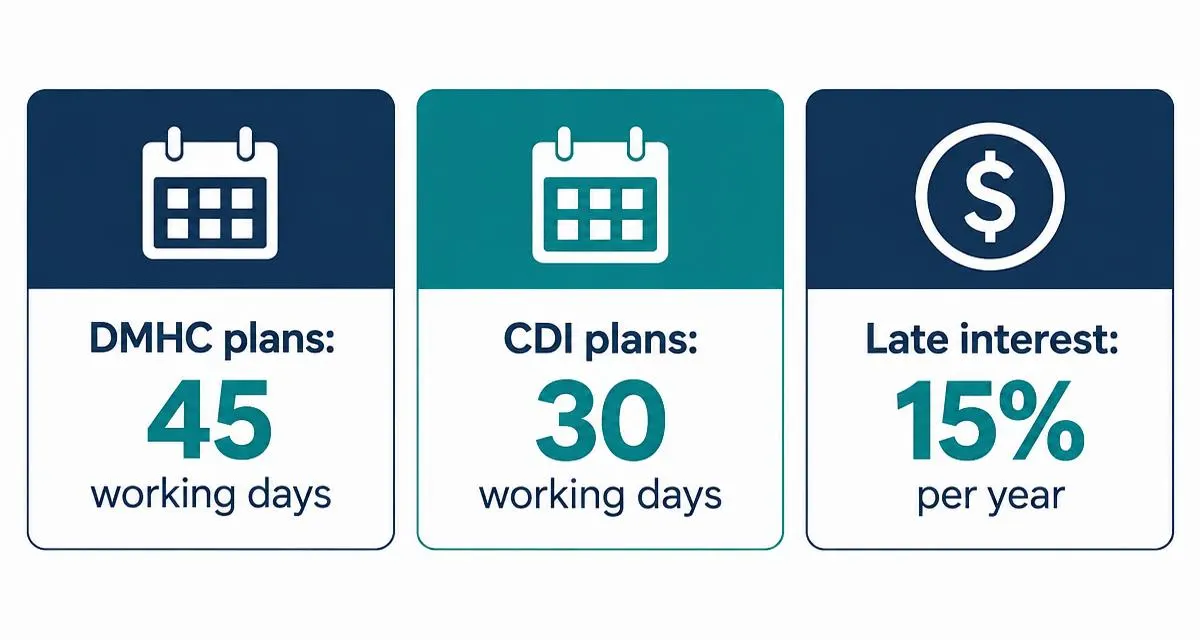
California payers must pay or contest a clean claim filed on time within a set number of working days, and owe interest when they pay late.
- DMHC-regulated plans (HMO / managed care): must reimburse or contest/deny a complete claim within 45 working days of receipt (California Health & Safety Code § 1371).
- CDI-regulated plans (PPO / indemnity): must reimburse or contest/deny within 30 working days of receipt (Insurance Code § 10123.13).
- Automatic late-payment interest: if a California commercial plan fails to pay an uncontested clean claim within the statutory window, the payer must automatically include 15% annual interest (or a $10 minimum for emergency services) without the provider requesting it. If it fails to add interest, it owes an additional $10 penalty.
2026 update: for claims received on or after January 1, 2026, AB 3275 changes these payment and penalty rules. See our AB 3275 prompt pay law guide and late-payment interest calculator guide for the current figures.
Good Cause Exceptions: Can You Overturn a Late-Filing Denial?
Yes. 28 CCR § 1300.71(b)(4) prevents California plans from automatically upholding a timely filing denial if the provider shows good cause for the delay.
Accepted good cause reasons
- Incorrect insurance information: the patient gave expired, incomplete or incorrect coverage details at the time of service, and your practice billed the wrong carrier first in good faith.
- Retroactive eligibility changes: coverage was retroactively terminated or activated after the date of service.
- System or clearinghouse outages: documented technical failures beyond the provider's control delayed electronic transmission.
- Coordination of benefits delays: the delay came from waiting for a primary payer (such as Medicare or workers' compensation) to adjudicate the primary claim.
How to win a good cause appeal
- File a formal Provider Dispute Resolution (PDR) within 365 days of the denial.
- Attach dated clearinghouse acceptance reports (277CA) and initial claim submission logs.
- Add eligibility verification timestamps.
- Include the primary payer's EOB showing why the claim could not be filed earlier.
Our guide to disputing and appealing denied claims in California walks through the full PDR process, and our denial management services handle these appeals for practices.

4 Best Practices to Eliminate Timely Filing Write-Offs
Timely filing write-offs are prevented by fast charge entry, upfront eligibility checks, weekly A/R reviews and correct IPA routing.
| Practice | Target |
|---|---|
| Submit clean claims | Within 48 to 72 hours of service |
| Verify eligibility | Before every encounter |
| Audit A/R buckets | Weekly; flag unpaid claims at 45 days |
| Track IPA vs. health plan routing | Updated routing table for every local IPA |
- Submit clean claims within 48 to 72 hours: never wait until day 60 to work charge entry. Submitting within 3 business days of service leaves a wide buffer to resolve clearinghouse rejections before the 90-day clock expires.
- Verify eligibility before every encounter: confirm active DMHC/CDI plan status, IPA or medical group delegation (critical for California capitated HMOs) and secondary coverage before the visit. Our eligibility verification services cover this step.
- Audit your 30- and 60-day A/R buckets weekly: flag any unpaid claim sitting at 45 days without a remittance advice. Proactive A/R follow-up services trace missing claims and resubmit them well inside the 90-day window.
- Track delegated IPA vs. health plan routing: sending a claim to the health plan when financial risk is delegated to an IPA or medical group can burn weeks off your filing clock. Read our IPA, capitation and DOFR billing guide for routing details.
Stop Losing Revenue to Missed California Payer Deadlines
Managing 90-day contracted windows, delegated IPA routing and 365-day Provider Dispute Resolution appeals requires dedicated daily oversight.
At California Billing, our California-focused RCM specialists monitor your claims from day one through our medical billing services. Is aging A/R or late-filing denials costing your practice money? Contact our team to talk through your claims.
Sources
Frequently asked questions about California commercial timely filing
At least 90 calendar days for contracted providers and 180 calendar days for non-contracted providers, counted from the date of service under 28 CCR § 1300.71(b). Your contract may allow longer.
Can't find what you're looking for? Contact our billing specialists