


November 18, 2026 · Muhammad Azam · 17 min read

The UB-04, officially Form CMS-1450, is the standard claim form that hospitals and other institutional providers use to bill Medicare, Medi-Cal, and commercial insurers for facility services. It holds 81 numbered fields called form locators (FLs) that describe the patient, the payer, the stay, every charge, and the diagnoses and procedures behind them.
The National Uniform Billing Committee (NUBC) maintains the UB-04 data set and its code lists. The Centers for Medicare & Medicaid Services (CMS) adopts that data set for Medicare, and nearly every U.S. payer, including California's Medi-Cal program, accepts it. The paper form replaced the UB-92 in 2007, and its electronic twin is the ASC X12 837I transaction.
This guide explains each section of the form, the codes that drive payment, how the paper form maps to the 837I, the rules that change for California payers, and the errors that cause most institutional denials. If you would rather hand the work to a team that files UB-04 claims every day, see our medical billing services or browse more medical billing resources.
What is the UB-04 claim form?
The UB-04 is a uniform institutional bill: one data set that any payer can read, so a facility does not need a different form for each insurer. "Uniform Bill" is the UB; "04" is the year the NUBC approved the design.
Three facts define it:
- It bills the facility, not the clinician. It carries room and board, nursing, supplies, drugs, lab, imaging, and other facility charges, grouped by revenue code.
- It is code-driven. Payment depends on the Type of Bill, revenue codes, HCPCS/CPT codes, ICD-10 codes, and condition, occurrence, and value codes, not on free text.
- It is the same data in two formats. Most claims travel electronically as an 837I; the paper UB-04 is the printed layout of the same fields.
Who uses the UB-04?
Any provider billing for institutional (facility) services uses the UB-04. That includes:
- Acute care hospitals, inpatient and outpatient
- Critical access hospitals (CAHs)
- Skilled nursing facilities (SNFs) and swing beds
- Inpatient rehabilitation facilities (IRFs) and long-term care hospitals (LTCHs)
- Inpatient psychiatric facilities and community mental health centers (CMHCs)
- Home health agencies (HHAs) and hospices
- End-stage renal disease (ESRD) dialysis facilities
- Rural health clinics (RHCs) and federally qualified health centers (FQHCs)
- Ambulatory surgery centers, when the payer requires an institutional claim
Physicians, nurse practitioners, therapists in private practice, and other individual clinicians bill on the CMS-1500 claim form instead. When a hospital-employed physician sees a patient, the hospital bills its facility charges on a UB-04 and the physician's professional fee goes on a CMS-1500, so one encounter often produces two claims.
UB-04 vs. CMS-1500 at a glance
| Attribute | UB-04 (CMS-1450) | CMS-1500 |
|---|---|---|
| Claim type | Institutional (facility) | Professional (clinician) |
| Fields | 81 form locators | 33 numbered items |
| Electronic version | 837I | 837P |
| Charge grouping | Revenue codes (FL 42) | CPT/HCPCS per line (Item 24D) |
| Inpatient procedure codes | ICD-10-PCS (FL 74) | Not used |
| Typical payment method | DRG, APC, per diem, HIPPS | Fee schedule (e.g., Medicare PFS) |
| Paper color | Red OCR ink | Red OCR ink |
| Data set owner | NUBC | NUCC |
How many boxes are on the UB-04?
The UB-04 has 81 form locators. Several are subdivided (FL 3a/3b, FL 67A–67Q, FL 74a–74e), and a handful are unlabeled or reserved for future NUBC use, so the number of fields you actually complete is lower. Each page holds 22 service lines, with line 23 reserved for the page count, creation date, and total charges (revenue code 0001). Medicare accepts claims up to 450 lines, or 9 paper pages, according to CMS Claims Processing Manual Chapter 25.
The form reads top to bottom in five zones: provider and patient, claim events and codes, service lines, payer and insured, and clinical coding.
UB-04 form locators explained (FL 1–81)
The table lists every form locator, what it holds, and its Medicare status. "Situational" means required only when the condition applies. Commercial and Medi-Cal rules can differ; the California section covers the main differences.
| FL | Field name | What goes in it | Medicare |
|---|---|---|---|
| 1 | Billing provider name, address, phone | Facility name, street, city, state, 9-digit ZIP | Required |
| 2 | Pay-to name and address | Only if payment goes to a different address than FL 1 | Not required |
| 3a | Patient control number | Your account number for the claim | Required |
| 3b | Medical/health record number | Patient's chart number | Situational |
| 4 | Type of Bill (TOB) | 4-digit code: leading 0 + facility type + bill classification + frequency (e.g., 0111) | Required |
| 5 | Federal tax number | Facility EIN, NN-NNNNNNN | Required |
| 6 | Statement covers period | From/through dates of the services on this bill | Required |
| 7 | Unlabeled | Reserved | Not used |
| 8 | Patient name and identifier | Last, first, middle initial; ID if different from insured | Required |
| 9 | Patient address | Full mailing address | Required |
| 10 | Patient birth date | MMDDCCYY | Required |
| 11 | Patient sex | M, F, or U per payer rules | Required |
| 12 | Admission/start of care date | Inpatient and home health admission date | Inpatient/HH |
| 13 | Admission hour | Hour code of admission | Not required |
| 14 | Priority (type) of admission or visit | 1 emergency, 2 urgent, 3 elective, 4 newborn, 5 trauma | Required |
| 15 | Point of origin | Where the patient came from (e.g., 1 non-health-care facility, 4 transfer from hospital) | Required (except TOB 014x) |
| 16 | Discharge hour | Hour of discharge | Not required |
| 17 | Patient discharge status | 2-digit status as of the through date (e.g., 01 home, 03 SNF, 20 expired) | Required |
| 18–28 | Condition codes | Up to 11 two-character codes describing conditions affecting payment | Situational |
| 29 | Accident state | State where an accident occurred | Not used by Medicare |
| 30 | Unlabeled | Reserved | Not used |
| 31–34 | Occurrence codes and dates | Events tied to the claim (e.g., 11 onset of symptoms, A3 benefits exhausted) | Situational |
| 35–36 | Occurrence span codes and dates | Events with a date range (e.g., 70 qualifying stay for SNF) | Required for inpatient |
| 37 | Unlabeled | Reserved | Not used |
| 38 | Responsible party name and address | Party responsible for the bill | Not required |
| 39–41 | Value codes and amounts | Monetary or unit values (e.g., 80 covered days, 54 newborn birth weight) | Required |
| 42 | Revenue code | 4-digit revenue code per charge line; 0001 for total | Required |
| 43 | Revenue description | Text description; also NDC (N4 qualifier) and IDE numbers | Not required |
| 44 | HCPCS/rates/HIPPS code | CPT/HCPCS with up to 4 modifiers (outpatient), accommodation rate (inpatient), or HIPPS code (SNF, HH, IRF) | Required |
| 45 | Service date | Line item date of service | Required outpatient |
| 46 | Service units | Days, visits, or HCPCS units | Required |
| 47 | Total charges | Charges per line; grand total on line 23 | Required |
| 48 | Non-covered charges | Non-covered portion per line | Required if any |
| 49 | Unlabeled | Reserved | Not used |
| 50A–C | Payer name | Primary, secondary, tertiary payer | A required |
| 51A–C | Health plan ID | Payer's ID number for your facility | A required |
| 52A–C | Release of information | Y or I | Required |
| 53A–C | Assignment of benefits | Y or N | Not used by Medicare |
| 54A–C | Prior payments | Amount already paid by that payer | Situational |
| 55A–C | Estimated amount due | Amount expected from the payer | Not required |
| 56 | Billing provider NPI | 10-digit National Provider Identifier | Required |
| 57A–C | Other provider ID | Legacy or payer-specific ID | Not used by Medicare |
| 58A–C | Insured's name | Name on the policy | Required |
| 59A–C | Patient's relationship to insured | 18 self, 01 spouse, 19 child, G8 other | Required |
| 60A–C | Insured's unique ID | Member ID or Medicare Beneficiary Identifier (MBI) | A required |
| 61A–C | Insurance group name | Employer plan or group name | Situational |
| 62A–C | Insurance group number | Group or policy number | Situational |
| 63A–C | Treatment authorization code | Prior authorization, referral, or Medi-Cal TAR number | Situational |
| 64A–C | Document control number | Original claim number for a corrected or void claim | Situational |
| 65A–C | Employer name | Insured's employer | Situational |
| 66 | Diagnosis/procedure code qualifier | 0 = ICD-10 | Required |
| 67 | Principal diagnosis code | ICD-10-CM code + present on admission (POA) indicator | Required |
| 67A–Q | Other diagnosis codes | Up to 17 secondary diagnoses + POA | Situational |
| 68 | Unlabeled | Reserved | Not used |
| 69 | Admitting diagnosis | Condition at admission (inpatient) | Required inpatient |
| 70a–c | Patient's reason for visit | Reason for an unscheduled outpatient visit | Situational |
| 71 | PPS code | DRG or other PPS code | Not used by Medicare |
| 72a–c | External cause of injury codes | ICD-10-CM V, W, X, Y codes + POA | Payer-specific |
| 73 | Unlabeled | Reserved | Not used |
| 74 | Principal procedure code and date | ICD-10-PCS code (inpatient only) | Situational |
| 74a–e | Other procedure codes and dates | Up to 5 more ICD-10-PCS codes | Situational |
| 75 | Unlabeled | Reserved | Not used |
| 76 | Attending provider | NPI, qualifier, last and first name | Required (most claims) |
| 77 | Operating physician | NPI and name when surgery is billed | Situational |
| 78–79 | Other provider | Referring (DN), other operating (ZZ), or rendering (82) provider | Situational |
| 80 | Remarks | Free text the payer needs | Situational |
| 81a–d | Code-code field | Qualifier + code, such as B3 + taxonomy code | Situational |
Source: CMS Medicare Claims Processing Manual, Chapter 25, §75. Full code lists for every FL are in the NUBC Official UB-04 Data Specifications Manual, which is licensed by subscription.
The codes that drive UB-04 payment
Five code sets decide how an institutional claim is routed, edited, and paid. Getting them right matters more than any other part of the form.
Type of Bill (FL 4)
The Type of Bill is a four-digit code that tells the payer what kind of facility sent the claim, what kind of care it covers, and where the claim sits in the episode. Medicare ignores the leading zero and reads the next three digits.
| Digit | Meaning | Common values |
|---|---|---|
| 1st | Leading zero | 0 |
| 2nd | Type of facility | 1 hospital, 2 SNF, 3 home health, 7 clinic (RHC, FQHC, ESRD), 8 special facility (hospice, CAH, ASC) |
| 3rd | Bill classification | 1 inpatient Part A, 2 inpatient Part B, 3 outpatient, 4 other |
| 4th | Frequency | 1 admit through discharge, 2 interim first, 3 interim continuing, 4 interim last, 7 replacement, 8 void |
Common examples: 0111 inpatient hospital, full stay; 0131 hospital outpatient; 0211 SNF inpatient; 0327 home health replacement claim; 0711 rural health clinic; 0771 FQHC; 0851 critical access hospital outpatient. A wrong frequency digit is a frequent cause of duplicate-claim denials, especially when a corrected claim goes out as "1" instead of "7."
Revenue codes (FL 42)
Revenue codes are four-digit codes that group charges by hospital department or service. Medicare requires them in ascending order, with 0001 as the final line holding total charges.
| Revenue code range | Department or service |
|---|---|
| 0100–0219 | Room and board (all-inclusive, private, semi-private, ICU, CCU) |
| 0250–0259 | Pharmacy |
| 0270–0279 | Medical/surgical supplies |
| 0300–0319 | Laboratory |
| 0320–0359 | Radiology, nuclear medicine, CT |
| 0360–0369 | Operating room services |
| 0420–0449 | Physical, occupational, and speech therapy |
| 0450–0459 | Emergency room |
| 0510–0519 | Clinic |
| 0636 | Drugs requiring detailed coding (HCPCS + NDC) |
| 0762 | Observation room |
| 0900–0919 | Behavioral health |
Outpatient revenue codes usually need a matching HCPCS/CPT code in FL 44, and the pair must make sense together. Billing a lab CPT under a pharmacy revenue code, for example, fails payer edits.
Condition codes (FL 18–28)
Condition codes flag circumstances that change how the claim is processed. Examples: 44 (inpatient admission changed to outpatient by utilization review), 20 (beneficiary requested a bill for a service the provider considers non-covered), and D9 (other changes on an adjustment claim).
Occurrence and occurrence span codes (FL 31–36)
Occurrence codes tie a significant event to a date, such as 01 (accident/medical coverage), 11 (onset of symptoms), or A3 (Part A benefits exhausted). Occurrence span codes tie an event to a date range, such as 70 (qualifying stay dates for SNF use) or 74 (non-covered level of care).
Value codes (FL 39–41)
Value codes pair a code with an amount or number. Common ones include 80 (covered days), 81 (non-covered days), 54 (newborn birth weight in grams), and 61 (CBSA where home health or hospice services were delivered).
Diagnosis and procedure codes (FL 66–74)
FL 66 is the ICD version qualifier; enter 0 for ICD-10. FL 67 holds the principal diagnosis, the condition found after study to be chiefly responsible for the admission, with its present on admission (POA) indicator (Y, N, U, W, or 1). For inpatient stays, the principal diagnosis, secondary diagnoses, and ICD-10-PCS procedure codes in FL 74 determine the MS-DRG, so a coding error here changes the payment directly.
Paper UB-04 vs. electronic 837I
The 837I is the HIPAA-standard electronic version of the UB-04, and it is the default for Medicare. Under the Administrative Simplification Compliance Act (ASCA), Medicare requires initial claims to be sent electronically unless the provider meets an exception or holds a waiver. The main exception covers small institutional providers billing a Part A contractor with fewer than 25 full-time equivalent employees; providers averaging fewer than 10 claims a month also qualify (CMS ASCA guidance via First Coast).
Every paper form locator has an 837I counterpart, so the field rules in this guide apply to both. A few practical differences:
| Topic | Paper UB-04 | Electronic 837I |
|---|---|---|
| Speed | Mail plus manual or OCR intake | Same-day clearinghouse acceptance reports |
| Front-end edits | Errors found after the payer receives it | Clearinghouse and payer edits return 277CA rejections within hours |
| Service lines | 22 per page | Up to 999 per claim in the X12 standard (payer limits vary) |
| Totals line | Revenue code 0001 on line 23 | Claim total in the CLM segment; no 0001 line needed |
| Attachments | Mailed with the claim | PWK segment or electronic attachment |
| Form requirement | Original red-ink form only | No form; data only |
If you print a UB-04, it must be an original form printed in red OCR "drop-out" ink. Black-and-white photocopies and downloaded PDF printouts cannot be scanned by payer optical character recognition systems and are usually returned unprocessed. Free UB-04 PDFs are fine as a reference or a training template, but not for submission.

UB-04 billing rules for California payers
California facilities complete the same 81 form locators as everyone else, but three payer groups add their own rules: Medicare through Noridian, Medi-Cal through DHCS and its managed care plans, and commercial HMOs.
Medicare (Noridian, Jurisdiction E)
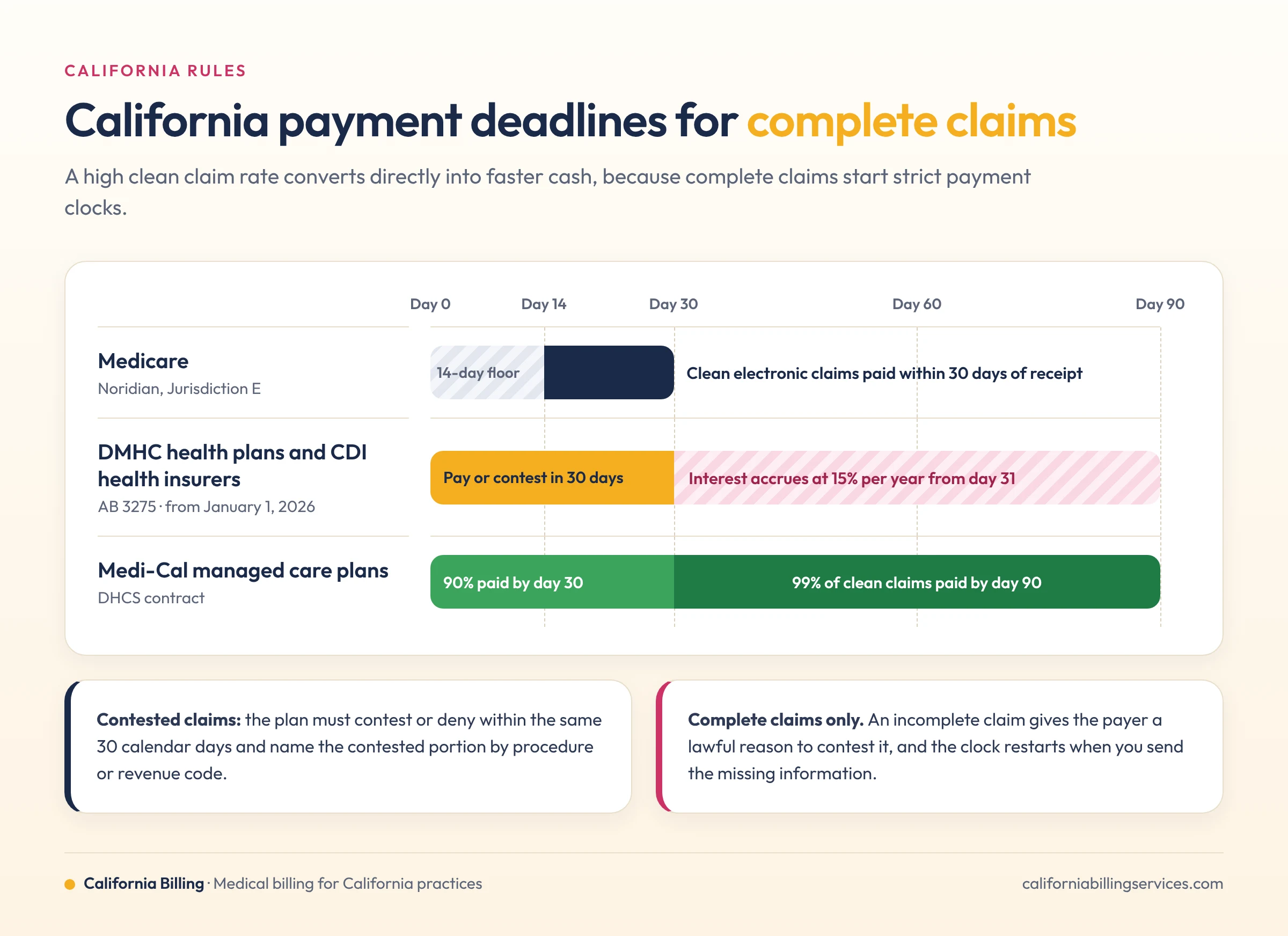
Medicare Part A claims from California institutions go to Noridian Healthcare Solutions, the Medicare Administrative Contractor for Jurisdiction E (California, Hawaii, Nevada, and the Pacific territories). Noridian follows CMS Chapter 25 field rules, requires the 837I unless an ASCA exception applies, and applies the standard Medicare timely filing limit of 12 months from the date of service. See Noridian JE Part A for local edits and claim status tools.
Medi-Cal fee-for-service and managed care
The Department of Health Care Services (DHCS) publishes UB-04 completion instructions for each facility type in the Medi-Cal Provider Manual on medi-cal.ca.gov. The points that trip up most California billers:
- TAR number in FL 63. Services that need a Treatment Authorization Request (TAR) must show the approved TAR control number in FL 63. Managed care plans such as Partnership HealthPlan of California use the same field for their own authorization numbers.
- Long-term care moved to the UB-04. Medi-Cal long-term care claims, once billed on the 25-1 form, must be submitted on the UB-04 as of January 1, 2024 (Partnership HealthPlan LTC billing guide).
- Inpatient hospital payment is DRG-based. Medi-Cal pays most general acute inpatient stays with APR-DRGs, so the principal diagnosis, secondary diagnoses, POA indicators, and ICD-10-PCS codes on the claim decide the payment, as with Medicare.
- Tight timely filing. Medi-Cal fee-for-service expects claims within six months of the month of service, and late claims are paid at a reduced rate or denied. Each managed care plan sets its own limit in its provider contract.
- Managed care routing. Most Medi-Cal members are in managed care plans such as L.A. Care, Health Net, CalOptima Health, and Partnership. Bill the plan, not DHCS, and check each plan's UB-04 instructions; Contra Costa Health Plan, for example, marks value codes as not required.
If you bill Medi-Cal heavily, our medical billing services team keeps current on DHCS bulletins and plan-specific edits.
Commercial plans and Kaiser Permanente
California commercial payers, including Kaiser Permanente, Blue Shield of California, Anthem Blue Cross, and Health Net, require the UB-04 or 837I for institutional services and expect the authorization number in FL 63. On the 837I, that number goes in Loop 2300, REF segment (Kaiser Permanente NCAL provider manual). Kaiser also accepts weekly interim bills for long inpatient stays where California law requires it.
How to fill out a UB-04, step by step
Complete the form in the order the payer will check it: identity first, then the stay, then charges, then coding.
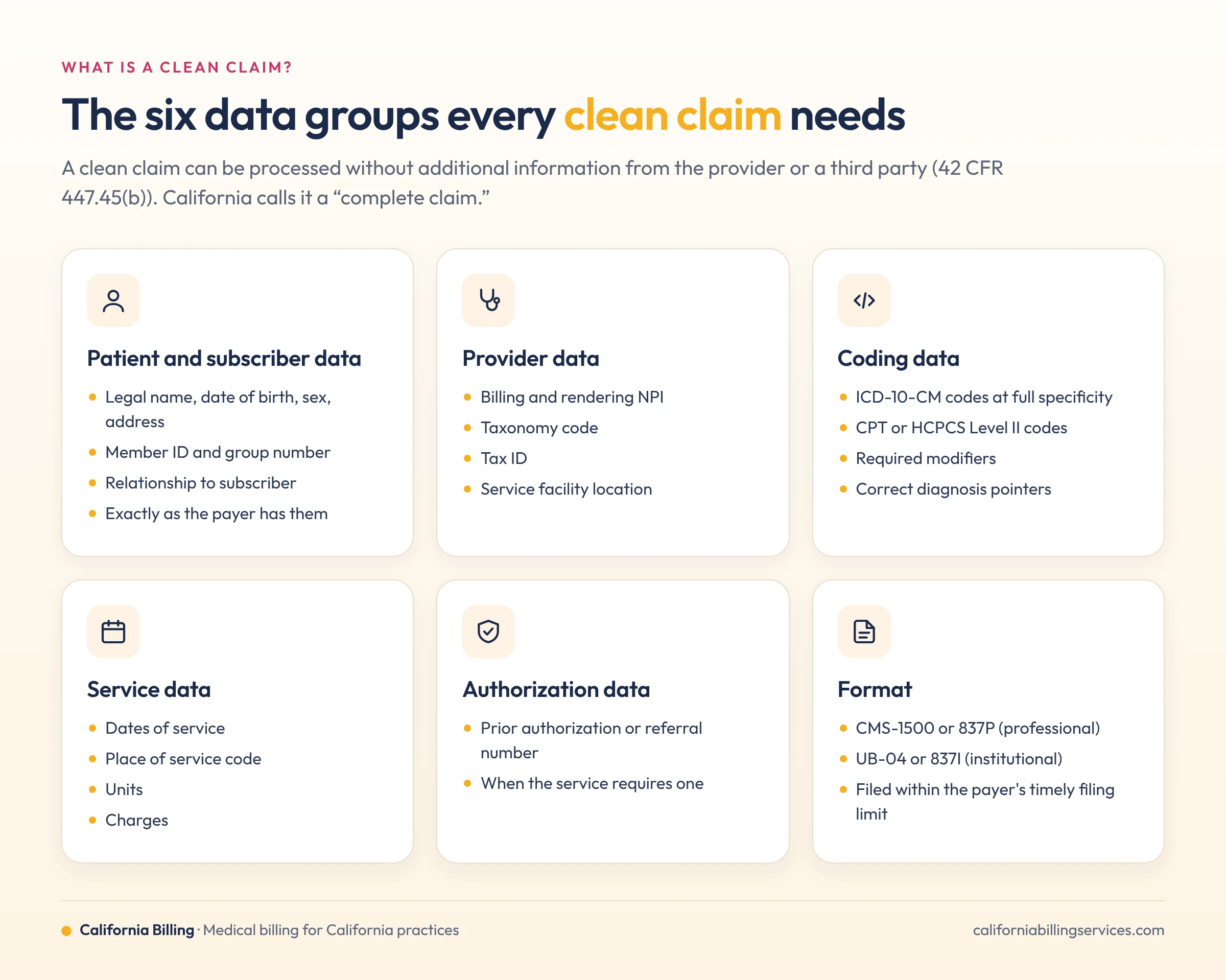
- Verify eligibility and authorization before service. Confirm the payer, member ID, and any prior authorization or TAR number. Missing authorization is a front-end problem that no amount of claim editing can fix.
- Enter the billing provider (FL 1, 5, 56). Use the facility name and 9-digit ZIP exactly as enrolled, the EIN, and the 10-digit NPI that matches the payer's records.
- Choose the Type of Bill (FL 4). Match facility type, bill classification, and frequency. Use frequency 7 or 8, plus the original claim number in FL 64, for corrections and voids.
- Enter the patient and stay (FL 3, 6, 8–17). Statement dates, demographics, admission date and type, point of origin, and discharge status must agree with the medical record.
- Add condition, occurrence, and value codes (FL 18–41). Only when they apply, in ascending order, using NUBC code lists.
- Build the service lines (FL 42–48). One line per revenue code, or per date of service for outpatient claims, with HCPCS/CPT, modifiers, units, and charges. End with revenue code 0001 and the total.
- Complete payer and insured data (FL 50–65). Primary payer on line A, secondary on B, tertiary on C, with matching member IDs and relationship codes.
- Code the diagnoses and procedures (FL 66–74). Qualifier 0, principal diagnosis with POA, secondary diagnoses, admitting diagnosis for inpatient, and ICD-10-PCS codes with dates.
- Identify the providers (FL 76–79). Attending NPI on almost every claim; operating NPI when surgery is billed; referring or rendering when the payer requires it.
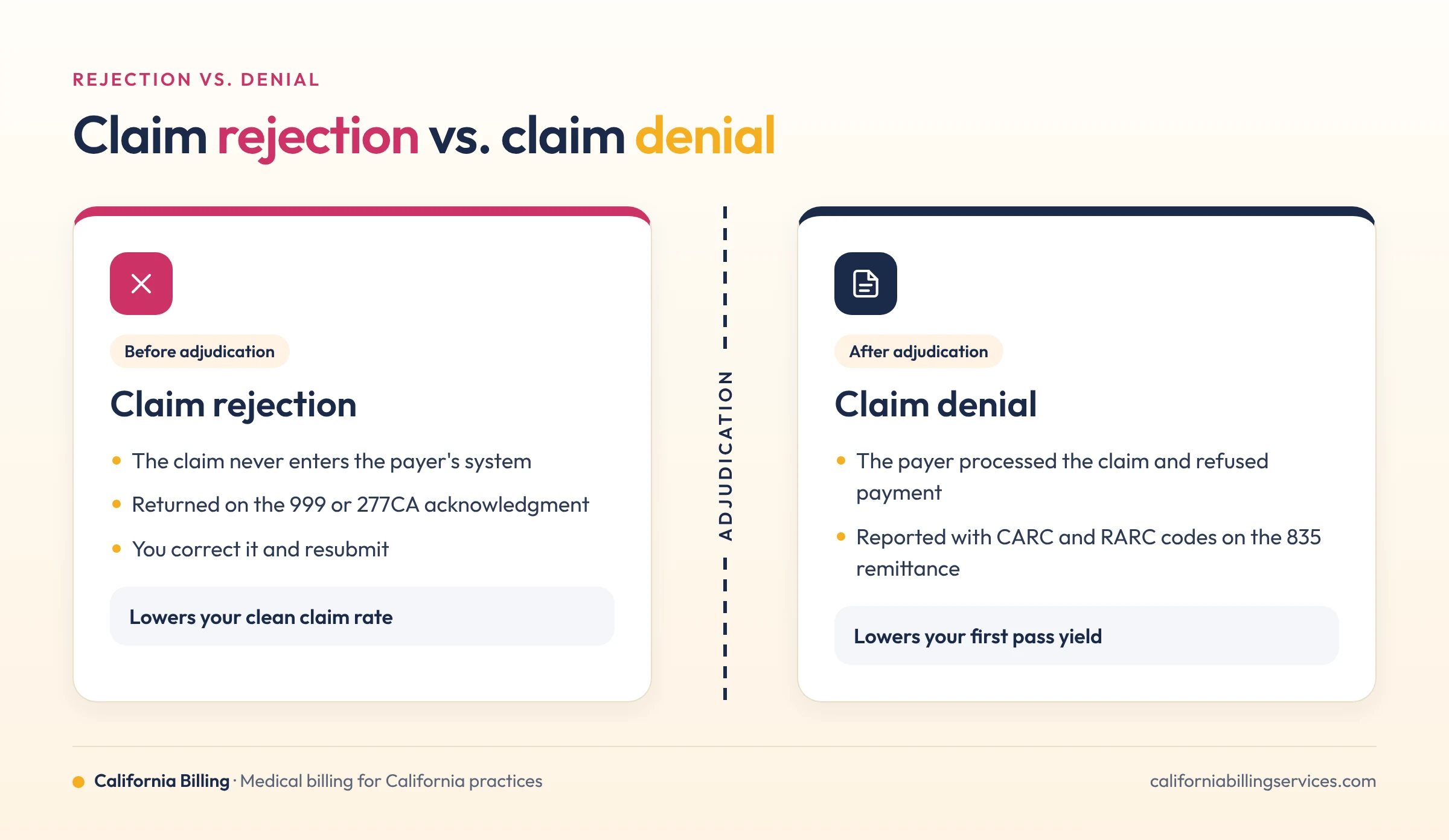
- Scrub and submit. Run the claim through a scrubber or clearinghouse edits, fix rejections, and track the 277CA acknowledgment and the 835 remittance.
Common UB-04 errors that cause denials
Most institutional denials trace back to a short list of field-level mistakes. Catching them before submission is cheaper than appealing afterward.
| Error | Form locator | Typical result | How to prevent it |
|---|---|---|---|
| Wrong frequency digit on a corrected claim | FL 4, FL 64 | Duplicate claim denial | Use 7 (replacement) or 8 (void) with the original claim number |
| Revenue code and HCPCS mismatch | FL 42, FL 44 | Line rejected by payer edits | Maintain a current chargemaster crosswalk |
| Missing or invalid authorization/TAR | FL 63 | Denial for no authorization | Verify and record authorization before service |
| Missing POA indicator | FL 67, 67A–Q | Rejection or lower DRG payment | Require POA on every inpatient diagnosis |
| Discharge status conflicts with the record | FL 17 | Payment adjustment, especially post-acute transfers | Confirm status against the discharge summary |
| Missing line-item service dates | FL 45 | Outpatient claim rejection | One date per line on outpatient bill types |
| NPI or taxonomy not matching enrollment | FL 56, FL 81 | Front-end rejection | Keep NPPES, Medicare, and Medi-Cal enrollment in sync |
| Units exceed medically unlikely edits | FL 46 | Line denial | Check MUE limits before billing |
| Late submission | All | Timely filing denial | Track payer-specific filing limits |
When denials keep coming back, the cause is usually upstream in registration, authorization, or charge capture rather than the form itself. A good denial management process traces each denial to its source field and fixes the workflow, not just the claim.
Key takeaways
The UB-04 is a structured data set, not a free-text form. Get the Type of Bill, revenue codes, ICD-10 coding, and authorization fields right and most claims pay on the first pass. For California facilities, add Noridian's Medicare edits, Medi-Cal's TAR and timely filing rules, and each managed care plan's instructions.
California Billing Services files UB-04 and 837I claims for hospitals, SNFs, home health agencies, hospices, RHCs, and FQHCs across the state. Talk to our medical billing team about cleaner institutional claims and faster payment.
Sources
This article is general information, not legal or coding advice. Confirm field rules in your payer contracts, provider manuals and the NUBC manual.
Frequently asked questions about the UB-04
The UB-04 is used by hospitals, skilled nursing facilities, home health agencies, hospices, dialysis centers, and other institutional providers to bill insurers for facility services. It reports room and board, ancillary charges, diagnoses, and procedures in a standard format every payer accepts.
Can't find what you're looking for? Contact our billing specialists